

It is on rare occasion that we do a guest post here, but friend to the blog, Midrats Podcast alumnus, and co-host the CavasShips podcast, Chris Servello put together an inspired review of the moment we are at, this decision point, our nation has as a naval power. A must read.
Chris, over to you.
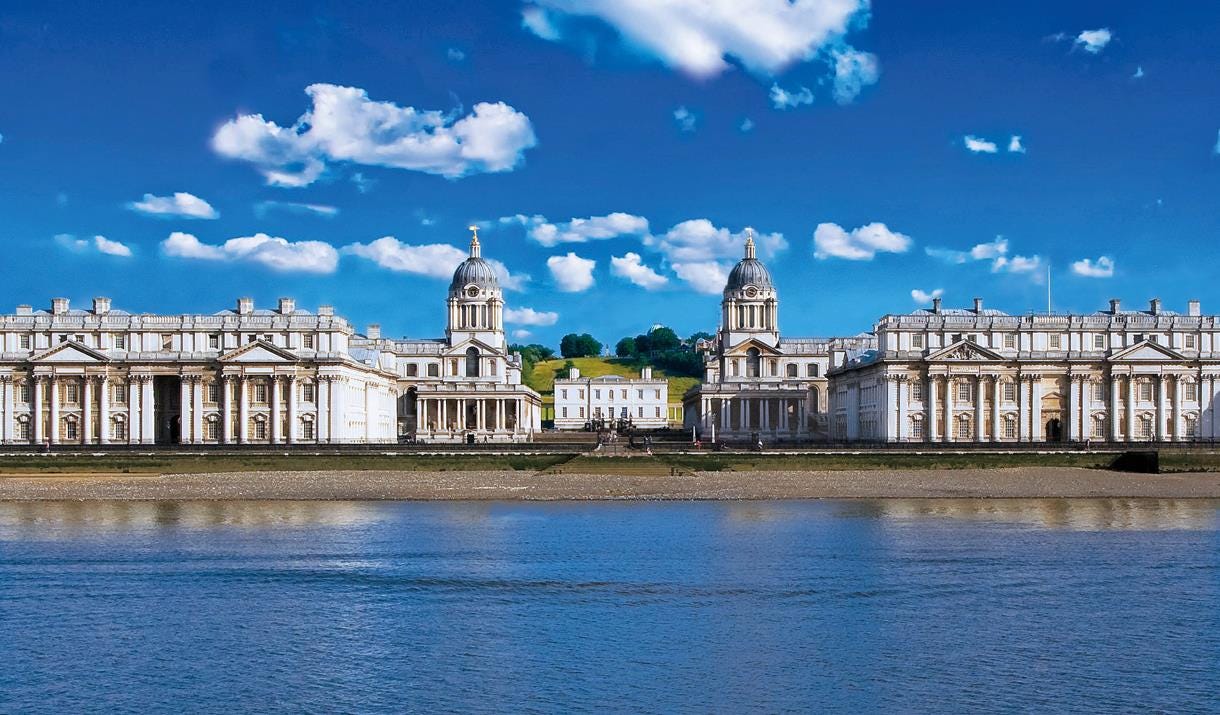
Standing in Greenwich, on the outskirts of London, surrounded by museum ships, artifacts and reminders of centuries of British seapower, I found myself thinking less about the past than about America’s maritime future.
That may sound like an odd conclusion to draw in a museum. But every gallery seemed to make the same point: naval power is not inherited forever. It depends on decisions made years before the consequences become obvious.
I came to London last week for APEX Europe, a thought and defense tech conference where defense leaders from across NATO are talking about the approaches, capabilities and investments that will shape future security. Those conversations felt more urgent after spending time in Greenwich. The museums made clear that maritime strength is about much more than ships. It depends on industrial capacity, technological imagination, national will and the willingness to act before a crisis makes action unavoidable.
That raises a difficult question for the United States: Are we making the decisions today that will preserve American maritime power tomorrow?
I’ll acknowledge something up front. I know I can sound like a broken record on this subject: act now, make hard choices, invest in the industrial base, embrace new technology, take care of our sailors and save our Navy.
But it’s hard not to keep saying it.
I can’t read another story about shipbuilding, listen to another speech about maritime strategy or visit another American or allied naval museum without reaching the same conclusion:
This is our moment.
For the United States Navy. For the maritime services. And for the nation.
Walk through the quaint town of Greenwich and you are surrounded by evidence of what maritime power meant to Britain—not just militarily, but economically, technologically and strategically. British seapower was never an isolated military capability. It was tied to the country’s industrial strength, commercial reach, technological innovation and national ambition.
What struck me most is that these museums are not really about old ships, paintings or artifacts.
They are about choices.
Some were smart. Some were disastrous. Some were made early enough to shape history. Others came only after events had made the cost of waiting impossible to ignore.
There is a lesson in that for America today.
Maritime power is not something a nation inherits forever because previous generations built a great Navy. Every generation has to choose it again.
Ours is making that choice right now.
We are making it through the ships we fund—and the ones we do not. Through the capacity we add to our shipyards, the workforce we recruit and retain, the weapons and munitions we procure, and the infrastructure we modernize.
We are making it through our willingness to experiment with autonomous and unmanned systems, super intelligence and other emerging technologies. More important, we are making it through our ability to move successful ideas out of demonstrations and into the hands of sailors.
And we are making it through our people: whether we give sailors, Marines, civilians and industry partners the resources, training, tools and leadership they need to solve hard problems instead of simply discussing them.
None of these challenges are secrets.
We know the condition of the American maritime industrial base. We know how long it takes to build and maintain ships. We know the pressures facing our workforce and supply chains. We can see the pace at which potential adversaries are expanding their maritime capacity.
We also know that technology is changing warfare at remarkable speed.
So this is not primarily a problem of awareness.
It is a problem of action.
America still has enormous advantages: remarkable sailors and Marines, world-class engineers and entrepreneurs, tremendous technological capacity, experienced allies and partners, and a private sector capable of moving quickly when given the opportunity.
But opportunities have expiration dates.
That is the part I keep coming back to—the part that, I admit, can make me sound like an old compact disc stuck on repeat.
Someday, there will be museums telling the story of the Navy we are building—or failing to build—right now.
Future generations will know what we knew.
They will know what China was building. They will know the condition of our shipyards and industrial base. They will know which technologies were emerging. They will know what military leaders, policymakers, analysts and industry executives were saying.
They will also know what we chose to do about it.
That is why protecting America’s maritime legacy is not about nostalgia. History should not become an excuse to admire the past while competitors build for the future.
The point of preserving history is to learn from it.
The museums in Greenwich are a powerful reminder of what can happen when a nation understands that its security, prosperity and global influence are inseparable from the sea. It is also a reminder that maritime dominance is neither permanent nor guaranteed.
America has its own extraordinary maritime inheritance.
But inheritance is not destiny.
We have to build. We have to experiment. We have to learn faster. We have to accept some risk and tolerate some failure. We have to expand industrial capacity, invest in our people and move promising technology from PowerPoint slides and demonstrations into the hands of sailors at sea.
Most of all, we have to act with the urgency this moment demands.
History will not simply record the challenges America faced during this period.
It will record the choices we made.
And the opportunities we either seized—or allowed to expire.
Chris Servello is the co-founder of Provision Advisors PR and Government relations firm, as well as the co-host of the award winning maritime podcast CavasShips.
"Someday, there will be museums telling the story of the Navy we are building—or failing to build—right now." Only if we still have a navy that bears the name of "United States". For that we have to stop "admiring the problem" with exhaustive studies that "admire the problems" we already know we have. Take action (as you say) is where we are now. Call it an inflection point, the knee in the curve, decision point, it's where we are. The maritime power we were, the one we are, and the one we possibly will be must get off the drawing board and into creation. The industrial capacity required to build the hulls and train the best sailors in the world can and should be dual purposed. It doesn't just create a navy, but add to the economic strength of the nation, creates jobs and opportunities for the younger generation. CDR Sal, you are not a broken record. You are the persistent alarm clock struggling to awake from slumber and get moving. Please don't stop.
The problem is not one of capability in building Things, it's capacity. But that capability is hamstrung by policy. Policy put in place to prevent people from making mistakes or to prevent them from running off on tangents in specifying requirements for the Things. And avoid the unnecessary. BUT rather then avoid the unnessary now, it just gets added to the laundry list of requirements - trying to cram more into the Thing - because that which is unnecessary now, "may" become necessary in the future.
Its not that Newport News, Electric Boat, Pascagoula, Bath, or Mobile cant make design changes at the direction of SUPSHIPS in order to build in more efficicency. They can. (or used to). Current policy just prevents it. Mostly so people supposedly in positions of responsibility can ulitmately avoid later liability, responsibility, and accountability - rightly or wrongly - if a future incident occurs and the witch hunt starts to hang someone for being "culpable".
Sea story time:
My dad was a pre-commissioning department head on the USS Theodore Roosevelt. He arrived after the keel was laid but before christening, and was there through major construction, builders trials, commissioning, shakedown cruises, and its first deployment. His undergrad degree was in maritime engineering from USNA; through the major construction and onward - Newport News would have monthly/ bi weekly meetings with the department heads and CO to provide design reviews, status updates and get feedback. According to dad it became a collaborative effort and they were able to make some good design inputs to create operational efficencies. He was pretty proud of that, because his inputs enabled the compartments of his entire department to be reconfigured within their overall space to do what they did, more efficently. (He probably got lucky - I don't think anything in his department was in a portion of the ship that was significanly structurally bearing and impacted hull strength.)
BUT probably the funniest bit involved the Senior Chaplain - as the Chaplain department head, Sr Chaps was in all those Dept head meetings. He was also incredibly short - allegedly he met the bare miniumum height requirement to be in the Navy. So in one of those meetings, he pitched a fit with the shipyard engineers about the height of the urinals on board. And the Newport News engineers said fine, we'll lower them 6 inches. SHIP-WIDE. And every Nimitz class carrier since has lower urinals built into them as a standard design feature. All because of one short chaplain.
So requirements changes CAN be made in-stride.