

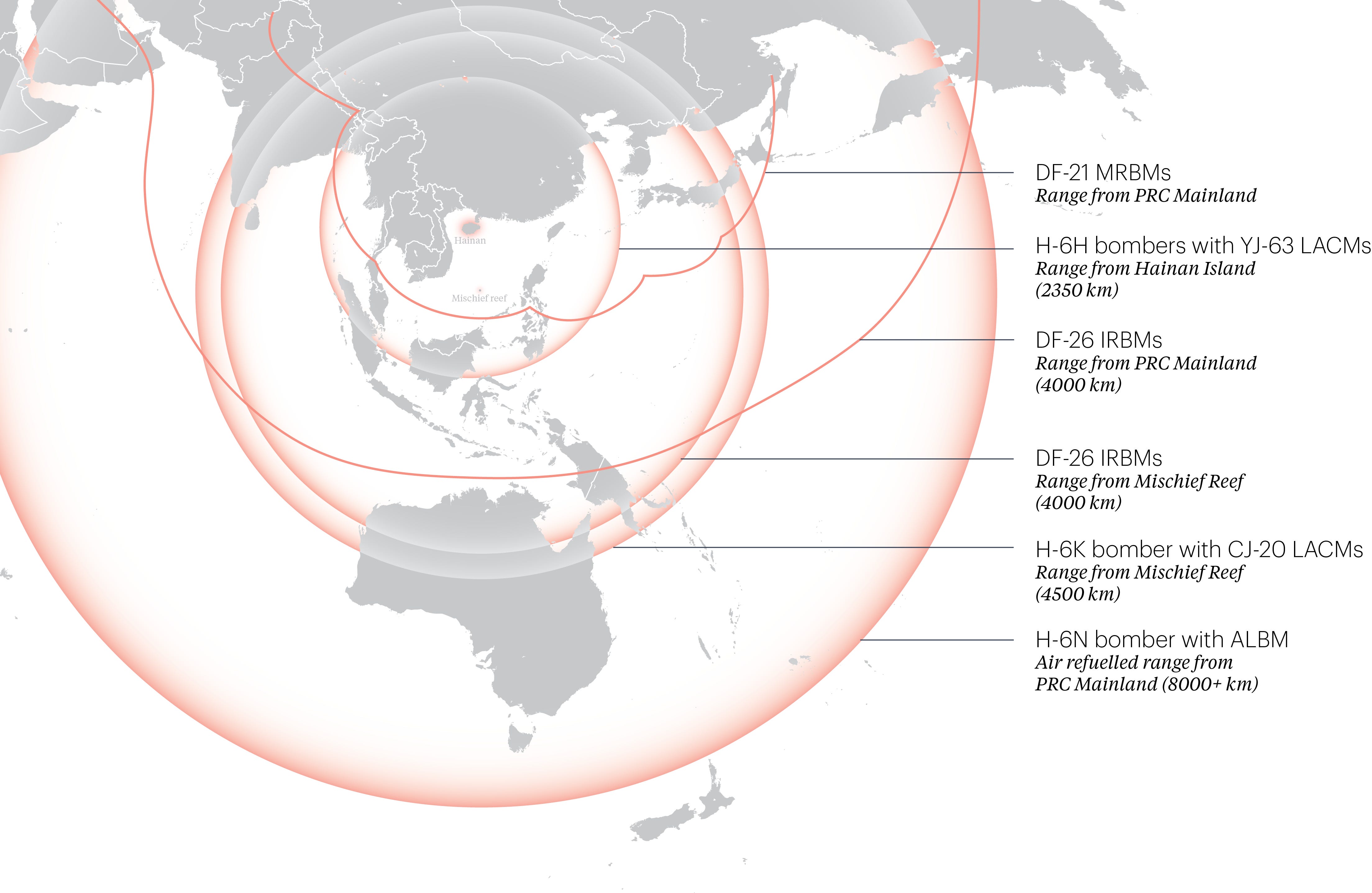
In my unending attempt to keep a well-rounded and diverse information flow, I was bouncing around and came across this quote from The West Australian.
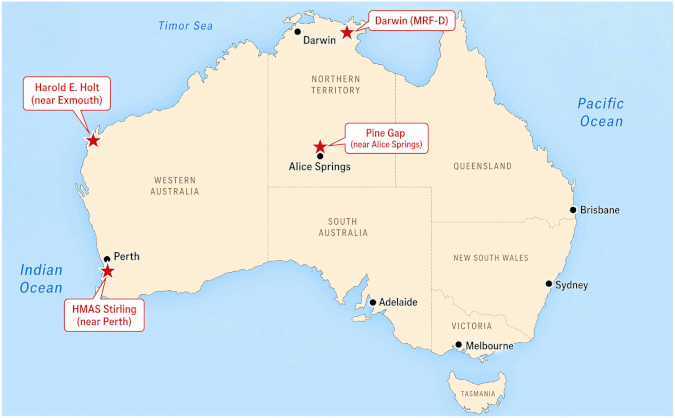
Privately, US officials are also alarmed at the protection levels of Australian bases, including HMAS Stirling and RAAF Base Darwin, where significant numbers of US personnel and military assets will be operating.
Earlier this month a conservative and influential Trump-aligned think tank urged Australia to spend billions buying US-made missile interceptors to defend key bases from Chinese military attack.
“At least three THAAD batteries and hundreds of interceptors to defend key bases, such as RAAF Base Darwin, from PLA attack, reducing the inventory and cost burden on U.S. inventories of scarce munitions and enhancing Australia’s ability to defend itself,” the Heritage Foundation’s Jim Fein recommended.
The Heritage Foundation report also called for the US Congress, Australia and Japan to fund “additional Indo–Pacific infrastructure improvements to harden them against ballistic missile attack, especially intermediate-range ballistic missiles”.
The referenced report came out on August 4th if you want to give it a full read.
If you’re curious about where the U.S. already has bases in Australia, or plans to have them (see HMAS Sterling near Perth for the AUKUS bit), this map is helpful to compare with the chart of the People’s Republic of China’s long-range strike capabilities that Fein is concerned about..
It isn’t just the American Heritage Foundation ringing the bell.
Digging around a bit got me to the Australian United States Study Centre (USSC) report that gives a great Australian perspective.
…in mid-2025, Richard Marles acknowledged that “China’s ever expanding war machine poses the greatest risk to Australia and the region’s stability.”11 He also publicly acknowledged that “Australia’s continental geography would become an issue in the event of a US-China conflict.”12
Defence of the homeland is now a significant priority for the Australian Defence Force (ADF) and the nation.
The last time this was a serious consideration was during the Second World War, when northern Australia was a major target, which saw at least 111 air raids between February 1942 and November 1943. The first and most significant of these raids was on 19 February 1942, when 188 aircraft bombed Darwin across two raids, the first by carrier aircraft at 9:57 am and the second by land-based bombers at 10:40 am. This combined raid dropped “115,000 kilograms of bombs…two and a half times the number of bombs and 83 per cent of the tonnage dropped on Pearl Harbour on 7 December 1941.”13 It was followed up with air raids during 1942 and 1943 across northern Australia, including Exmouth Gulf, Broome, Port Hedland, Wyndham, Derby, Horn Island and Townsville, and the submarine raids on Sydney and Newcastle in June 1942.
They’ve been here before.
ADF military capabilities must therefore manage the strategic risk. Key amongst these is the People’s Liberation Army Rocket Forces. This includes the DF-26 Intermediate Range Ballistic Missiles (IRBM) that can reach northern Australia from China’s artificial island bases in the South China Sea. Their new DF-27 IRBM, equipped with a hypersonic glide vehicle (HGV) warhead, is believed to have moved from development into deployment. This missile has a range of 5,000 km to 8,000 km and is “believed to be primarily [designed]…for regional conventional strikes during conflict.”17 The DF-27 brings virtually the entire Australian continent under risk.18
The People’s Liberation Army Air Force (PLAAF) H-6K bombers can range Australia with CJ-20 Land Attack Cruise Missiles (LACM) and Air-Launched Ballistic Missiles (ALBM). The PRC has also undertaken a major expansion of its submarine fleet, specifically its nuclear-powered guided-missile submarines (SSGNs). Over the last 15 years, the People’s Liberation Army Navy (PLAN) has built 12 new submarines, including four Type 093A Shang III class SSGNs, which provide a new class of anti-surface warfare and land-attack capabilities. The expansion of the PLAN’s SSN capability is part of its transition “from defense on the near seas to protection missions on the far seas.”19 It is estimated that China has built seven or eight Type 093B SSGN submarines, equipped with 12 vertical launch missile cells — including those for the YJ-21 hypersonic missile — in the past three years.
That will wake you up. Well, I hope it does. What is one of the greatest lessons from the Russo-Ukrainian War of 2022 and the ongoing conflict between Israel and the U.S. and Iran and her proxies? Simple: the normalization of the use of conventionally armed ballistic missiles with precision warheads.
How have the good folks Down Under responded in a period longer than they fought in WWII?
Currently, the Australian Army has very limited GBAD capabilities, with only two batteries of modern mid-tier National Advanced Surface-to-air Missile Systems (NASAMS) being brought into service. NASAMS is one of the world’s most advanced surface-to-air missile (SAM) systems, combat-proven against large UAVs, helicopters, aircraft and cruise missiles. Australia’s ground-based ballistic missile capabilities are, however, basically non-existent.
What is being done? Well, some nice problem appreciation and conferences.
Work has also developed tri-laterally in the Indo-Pacific to advance coordination in the Indo-Pacific. The AJUS countries — Australia, Japan and the United States — have agreed to establish a regional IAMD network to develop advanced capabilities. During the Japan Official Visit in April 2024, the United States and Japan announced their intention to partner with Australia to build a regional architecture that incorporates the three countries’ sensors, with plans to test this network during a live-fire exercise in 2027.82 Similarly, the United States and Australia announced during the Australian official visit in October 2023 that they would partner with Japan to develop collaborative combat aircraft that would team with manned fighter aircraft and perform support missions, such as aerial refuelling and intelligence, surveillance and reconnaissance.83 The partners have made incremental yet steady progress toward achieving this capability. This provides an excellent platform to advance regional IAMD coordination.
…
While the direction and intent of the review are clear, the DSR had one major failing: it left off a specific set of recommendations consistent with the text in the body of the document. The Australian Government’s direction to Defence to focus on the DSR’s recommendations and bureaucratic politics has contributed to a lack of funding for IAMD and an inadequate prioritisation in the 2024 National Defence Strategy (NDS) and Integrated Investment Plan (IIP).
The 2026 NDS and IIP are an opportunity to rectify this erroneous position.
Drafting aside, the intent of the DSR is clear, and the mission essential. The text of the DSR is clear — the current approach is not fit for purpose, and the need is urgent. IAMD must be “accelerated,” the focus must shift to delivering “minimum viable capability,” through “off-the-shelf options.”93
None of this has happened since the DSR was released.
There is already a line out the door for PAC-3, SM-3, SM-6, THAAD, and a pony for Christmas.
In comparison to the other options that are assessed below, such as the Typhon/Vertical Launch System (VLS) and THAAD options, the Patriot system emerges as the most viable option for the ADF.
The use of a VLS option — a system that operates on navy ships — would require a land-based solution, such as the experimental US Army Typhon system. This system is not a widespread, in-service option, with only two developmental batteries currently being fielded. The system includes large semi-trailer-sized launchers and battery operations centres, severely limiting its mobility and deployability with ADF transport assets.
…
AEGIS ashore system consists of AN/SPY radar, “located in a deckhouse that also supports the system’s command and control capabilities [with] Co-located…e fixed launchers for the current version of the SM-3 ballistic missile interceptor, the Block IB, as well as SM-6 air defense missiles.”124 The main issues with this system are its costs, limited development, and that it is a fixed system, negating mobility. Recent conflicts have demonstrated the vulnerability of fixed systems, and the cost was the principal reason for Japan suspending its development of this program. The two sites for Japan were to cost approximately A$1.367 billion each, with the total cost of the system coming to A$4.55 billion.125
Of note, Japan decided to mitigate risk by leaving Aegis Ashore behind and moving forward with their clunky-sounding Aegis System Equipped Vessels (ASEV), which is really just an air defense cruiser focused on strategic defense.
Very smart move by the Japanese. More flexibility and survivability that only going to sea can give you.
The THAAD system comprises missiles, ground-based radars (GBR), mobile launchers, support equipment, and a command-and-control centre. It is a more high-end, limited availability, and more cost-prohibitive system. Its approximate life-cycle cost is US$23 billion.126 It is limited in applicability to BMD, and the cost per missile is exceptionally expensive. A single interceptor costs between US$12 million and US$15 million.127 It is mainly used in the United States as part of the missile defence shield, known as the Golden Dome, for theatre ballistic missile defence aimed at deterrence against rogue nuclear missile strikes by countries such as North Korea.
In comparison to other options, the Patriot missile system offers the best MOTS option for medium-range air defence and defence against short- and medium-range ballistic missile defence, as well as manoeuvring hypersonic missile defence.128 Unlike most other options, it is an in-service and off-the-shelf option, offering a combat-proven record, a continuing development cycle and a relatively cost-effective system (compared to other options). Patriot can fire a range of missile options from the shorter-range PAC-2 and intermediate PAC-3-CRI, and the longer-range PAC-3 MSE.
The U.S. Navy had some great plans for their navalized version of the PAC-3 to fill the gap due to limited production capability of the SM-3 and SM-6, but I think history has other plans. The Free World’s demand for PAC-3 is simply too great. The Navy probably lost its window for an early batch and will have to wait for expanded production capabilities.
I think I’ve given everyone enough to read today. My pull quotes are only a small part of a much larger article.
The executive summary: the PRC has an answer for AUKUS, and AUKUS has to think about more weapons systems than just submarines. Australia is not a safe-space. She needs serious defense. Should war come to the Pacific, Australia will be hit—early, often, and hard.
Australia needs to get in the air defense business as soon as practical, with the best around Perth. Want to knock Australia out of the war quickly or at a minimum cause internal unrest? In strangely anti-nuclear Australia, sink a SSN pierside with a hypersonic missile and crack open the reactor…that would do it.
I would also recommend the USSC report that came out at the end of last week and includes among its authors Midrats Podcast alumni Bryan Clark, Advancing trilateral integrated air and missile defence between Australia, Japan and the United States.
From my seat, there cannot be enough integration of U.S., Australian, and Japanese defense concerns. They are both superb militaries and good friends, and our interests in the Western Pacific have 90% overlap.
So easy to sell. So important.
Can Australia stomach the idea of destroying the Three Gorges Dam? If so, it should develop the capability to do so. Then it should not-so-subtly announce its capability.
"Feel free to rain ballistic missiles down on us if you enjoy treading water."
Australia's population is very concentrated - 60% in 5 metro areas. Sea based defense would give them flexibility to shift coverage as needed to protect their assets and people.