
Europe's "Say v. Do" Problem
put your money where your requirements for national and collective survival are

From the “Strongly Worded Letter” department of the Rules Based International Order school, there are more nations signing up to so something to keep the free flow of goods at market price through the global Sea Lines of Communication (SLOC), of which the Strait of Hormuz is one of the most important.
Several more countries on Friday joined leading European nations, Japan and Canada in signing a joint statement, opens new tab saying they were ready to join appropriate efforts to ensure safe passage through the Strait of Hormuz and would take steps to stabilise energy markets.
This is the full text of the statement from Britain, France, Germany, Italy, the Netherlands, Japan, Canada, Republic of Korea, New Zealand, Denmark, Latvia, Slovenia, Estonia, Norway, Sweden, Finland, Czechia, Romania, Bahrain and Lithuania:
That sounds promising, but in the classic European model, it is rarely what it seems.
Merz made the remarks to reporters ahead of an EU leaders summit in Brussels, where discussions are expected to focus on the conflict, surging global energy prices, and disruptions in the vital Strait of Hormuz.
“I want us to send a clear signal that we are ready to help. But for that to happen, the fighting must cease,” Merz said, emphasizing that Germany would only join such a mission with an international legal mandate.
The chancellor welcomed signals from Washington indicating a willingness to pursue de-escalation. “I am particularly grateful that the US president sent a signal last night that he is also prepared to bring about an end to the fighting,” he said, though he noted this would require Iran to abandon its nuclear program and attacks on its neighbors and engage in negotiations.
So, yes—Europe’s great powers will do something, but only after it is not needed.
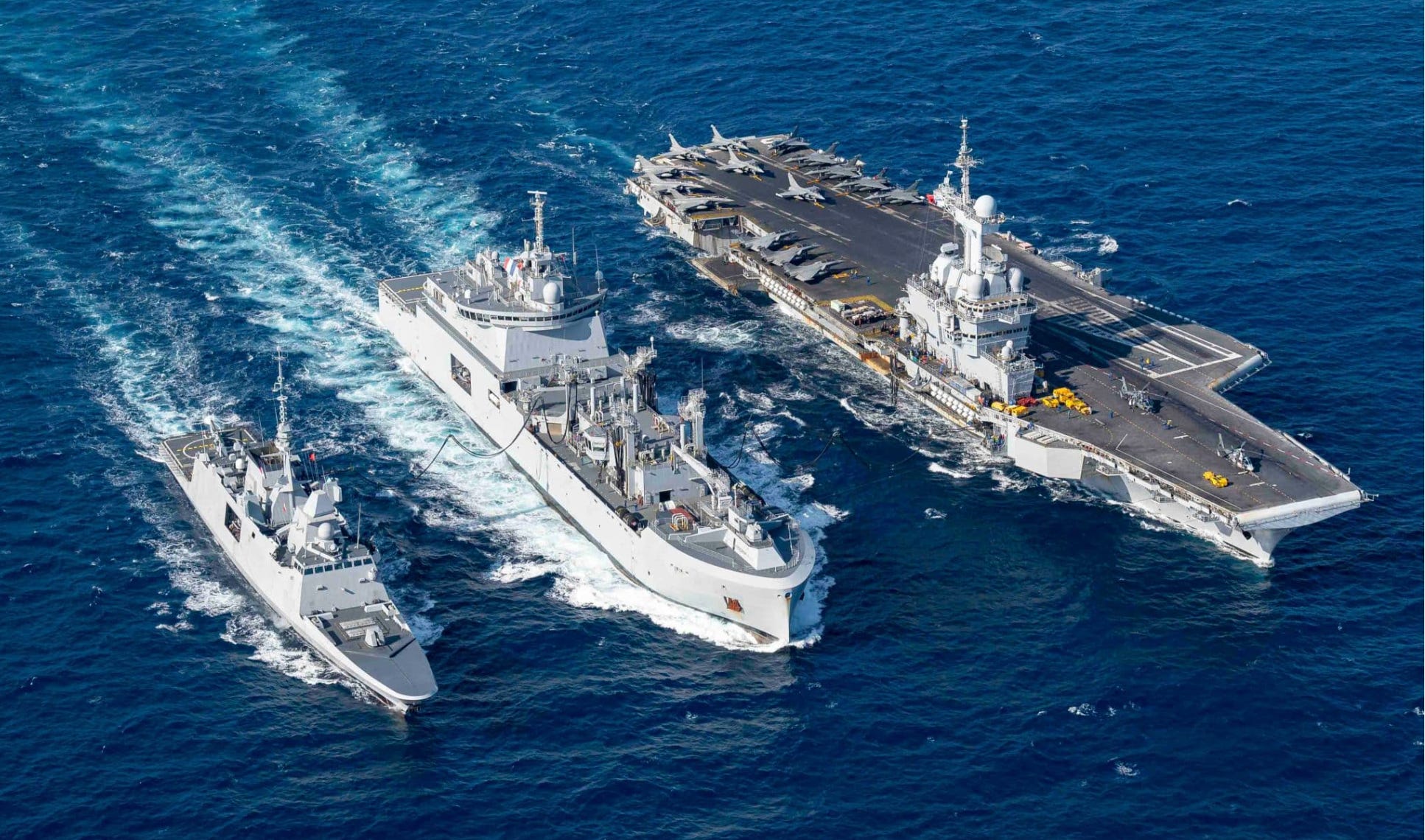
This is not dissimilar to the French-led Carrier Strike Group (CSG) to the Eastern Mediterranean after the very limited strikes from Iranian proxies in Lebanon against Cyprus. The Eastern Mediterranean is not where the threat is.
As I discussed on Sunday’s Midrats Podcast and Claire Berlinski’s Symposium with Toomas Hendrik, the FRA CSG on paper seems to be a demonstration of strength. What ships are in it?
The carrier group includes the air defence destroyer FS Chevalier Paul (D621), a FREMM-class frigate, a fleet oiler for logistics support, and a nuclear-powered attack submarine.
The deployment is also supported by allied vessels, including the Spanish Navy frigate ESPS Cristóbal Colón (F105) and the Royal Netherlands Navy frigate HNLMS Evertsen (F805).
France has also sent the frigate FS Languedoc (D653) along with a French Army ground-based air defence unit to strengthen protection for Cyprus.
So:
CVN: 1 (FRA)
DDG: 1 (FRA)
FFG: 3 (FRA, NLD, ESP)
AO: 1 (FRA)
SSN: 1 (FRA)
Not a bad CSG, but it is a bit light on capabilities for the full spectrum of modern threats, like much of Europe is. None of these ships have the ability to defend against Anti-Ship Ballistic Missiles (ASBM) we have seen in use over the last few years in the Red Sea by Iranian proxies. The Spanish ship is an Aegis ship with 48 MK-41 VLS cells, but is only armed with SM-2 Block IIIA. That is not a weapon designed to intercept ballistic missiles of any type—ASBM or other.
The other escorts are solid air defense platforms in their own right against whatever can be launched from Lebanon by Hezbollah. There are no indications at this time any of the Iranian long-range ballistic missiles—that I may write about tomorrow—are configured for the ASBM mode…so on paper, solid group…however…
This is a one-shot deployment. The French only have one aircraft carrier. It takes three to four carriers to consistently have one deployed expeditionary (one could argue an Eastern Mediterranean deployment for the French is a relatively low impact deployment comparable to the USN deploying to the Caribbean.
The only comparable carrier to the French one are the two British conventional carriers. Other NATO nations have light carriers, but they lack the full capabilities of the French CVN. Indeed, being that only the French have a robust AEW capability, really none of the other European power have an ability—desire aside—to relieve the French CVN in the Eastern Mediterranean.
That does not even address how to scrape together enough fully mission capable escorts of any nation.
That leads to a second demonstration of the limit of European naval power: national caveats.
Anyone who served in AFG and IRQ—or, heck, the 2011 operations against Libya—know that it does not matter so much what kind of asset is assigned to the CJSOR, but which nation it comes from. They may have weapon system X, but they can only use it for Y circumstances in Z location. You can add to that uncertainty that at any moment the ship contributing nation can decide it does not want to play anymore, and, like HMCS Uganda, just decide to go home and let the fighting be done by better men (& women).
This by no means should be construed to throw any shade on the individual serving in the European navies. I served with them and know that every one of them would have served with us caveat free—regardless of their personal feelings about the mission—but they serve their nations just as we serve ours, and follow legal orders. They are limited not by desire—or, for the best of them, capability—but by political direction and guidance, and capacity.
This brittle military stance is the byproduct of three and a half decades of underinvestment in their defense in general, and their naval power in particular. Especially Great Britain, France, Spain, and Italy—their navies should not only be more capable, they should be much larger. As maritime nations, their national and collective security in 2026 would be much more robust if their leaders in 1995, 2005, 2020, and 2015 has understood the world as it actually is—not what the people sitting on either side of them in Davos wished it to be.
And so, that brings us back to the strongly worded letter desiring to do something, at some time, to enable the free flow of hydrocarbons at market prices through the Strait of Hormuz via the ‘Tiffany-strong’ SLOC on the open seas.
Where will they get the ships that can address the full spectrum of threats from Shahed drones to ASBM if, as it appears (and in this political environment is probably an entering argument requirement) it will be done outside a U.S. led command structure and USN warships? Looking at the possible ship contributing nations, they better be able to convince the Japanese to send along one of their Maya, Atago, and Kongō class destroyers and their SM-3.
Of course, the USN DDGs could slyly hang around, “doing their own thing” and with a wink, get our friends under their umbrella…but a note of caution…like the national caveat issues above, national tasking will take priority.
GBR, FRA, ESP, ITA especially, but I’d add GRC, DNK as well — your comparative advantage to your national and collective defense is at sea. Yes, you need a land component, but your navies are not fit for purpose in size or capability. Hedge your collective defense ashore in the capable hands of DEU, POL, and the former Habsburg possessions in Central Europe.
You can’t build a proper navy overnight. It takes a few decades. Take a deep breath and invest.
The U.S. is leaning in as well and has some neat developments that might help some…and JPN and South Korea can help on the industrial technology side if you ask.
This latest Iranian crisis will not last much longer, one way or another, but the shortfalls of European power at sea—that everyone has seen from the Red Sea to Portsmouth—will remain.
Let’s hug-out our differences and get to work.
Get rid of the EU and watch individual European countries take their own defense more seriously.
We've all seen people like this at work, or in the service.....They show up after the work is done, and then slap themselves on the back for their good deeds.
And now that the majority of the work is done, they will suck up US resources, get in the way and should anything actually risky be happening will have to phone home to get permission to actually do anything, including defend themselves - while demanding the US protect them,
The US should set up a toll booth in the Strait, and charge a toll for every barrel that leaves.