
Fullbore Friday
I need volunteers

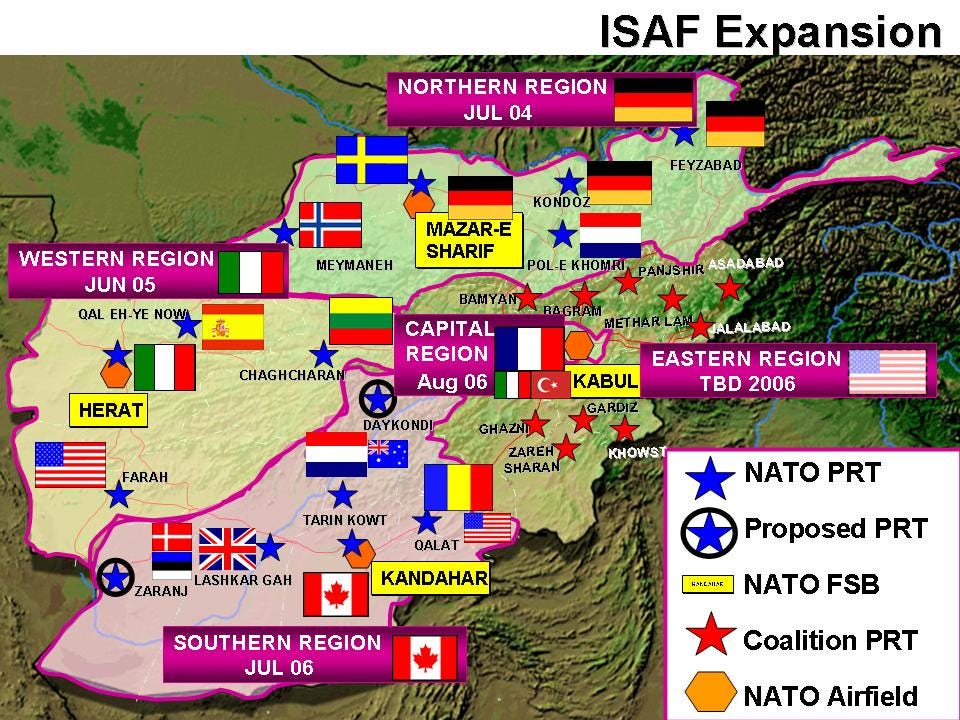
Remember my 2017 article about the then “Seven Act Play” that was the effort in Afghanistan? Well, we’re going to visit part of Act-3:
Act 3: Buyer’s Remorse – By late 2006, the NATO-sceptics’ critique started to break above the happy-talk. AFG was more serious than NATO and the USA were saying, and most of the alliance members were not up to the challenge, and if they were – their staying power was brittle at best.
If you had to draw the line somewhere, it would have been the summer of 2007 when NATO failed to fill the rotary-wing aviation bridging force. At the last minute, a combination of US military and civilian contractors filled the gap. After that goat rope, it was clear that NATO culminated. It was clear to the Americans in NATO and at the U.S. Joint Staff.
Planning began to, in unkind terms, take back the keys … as long as the surge in Iraq worked. Some of the larger minimal-caveat maneuver forces, the Dutch and the Canadians, had already signaled they had enough and were going home. We needed to not only replace them over time, but increase the national presence overall.
Bit by bit, RC by RC, we took the keys back.
2007 was a pivot point in Afghanistan. A few years earlier than that in 2005, NATO decided it could take control of the country, and set about creating this Regional Command (RC) structure that only NATO could devise.
People forget how broken, and broken up, things were. How tribalistic it was…not the Afghans, but NATO.
You had the Turks in RC(C) in Kabul, driving around with Turkish flags on their vehicles to remind the bad guys to try to kill other NATO allies, but not them. It worked.
You had RC(W) run by the Spaniards and Italians who were pretty much a static force, rarely leaving the airfield fence outside Herat.
Not quite as caveat laden as the Spaniards & Italians, in RC(N) you had the Germans running the show from their very nice, orderly, and three-beer-hall-studded base at Mazar-i-Sharif. They got sporty a few times, but by accident.
The Americans were in RC(E) fighting their own fight that none of the other allies with their binders full of national caveats—with a few exceptions—would do (specifically the Counter Terrorism (CT) mission).
In RC(S), you had the Brits, Canadians, Dutch, Danes, Australians, Estonians and a few other formations generally in the fight like the Americans.
It wasn’t supposed to be that way, but it got that way, and some of those nations, at least for a while, leaned in, especially the Brits who already had three Afghan wars under their belt and knew where the forts were.
Toward the end of 2006, things seemed to be getting wobbly, but NATO said they had it under control, but they didn’t.
The U.S. was in the midst of the general uprising in Iraq and had our hands full, so we were willing to let NATO do its best as they promised. Eventually, as Iraq settled down, it allowed the 2008 and 2009 uplift of forces we worked so hard on to start showing up, but that was in the future.
Let’s get back to 2007 when hints that things were getting worse were becoming clear. That is where we will pick up today’s story.
A great tradition in the Anglosphere military is simple, never leave a man behind.
In January 2007, a group of Royal Marines threw together a crazy mission to rescue a wounded Marine trapped inside the compound. To get him back, four Marines strapped themselves to the outside of Apache helicopters and rode back into the compound.
The situation arose after an attack on Jugroom Fort went sour quickly. The Brits assaulted in armored vehicles with artillery and Apache support, but the insurgents returned a heavy volume of fire when the Marines dismounted. Poor communication during the raid led to a friendly-fire incident and another miscommunication led to the Marines withdrawing without Lance Cpl. Mathew Ford.
…
After rallying back up, the Marines quickly realized Ford was missing and one of the two Apaches on the battlefield spotted what appeared to be a human silhouette just inside the compound with his infrared sensors. The Royal Marines quickly devised the plan to strap two Marines each to two Apaches and have them land just outside the compound. They would recover Ford, who appeared to be severely wounded, and then ride back out.
Liveth For Evermore made a nice video of the mission, including original video of the extraction from a distance. Give it a watch for the rest of the story.
Fullbore.
h/t Paul.
Reminds me of this one I read about the year after I left Iraq (could have sworn there was something similar while I was stationed in BIAP too, but I'm probably conflating stories): https://www.nationalguard.mil/News/Article-View/Article/573012/apache-pilots-save-critically-wounded-soldier-with-unorthodox-evacuation/
"Chief Warrant Officer-4 Kevin Purtee and Chief Warrant Officer-2 Allen Crist, two Apache helicopter aviators flying their last combat mission, are credited with assuring a Soldier of Company A, 1st Battalion, 77th Armor, of prompt medical care by their actions. The Soldier had been shot in the face and the arm, and needed to be evacuated from a raging battle near Donkey Island in Ramadi.
The pilots learned that more than 40 minutes had elapsed since the ground unit had called for the medical evacuation aircraft to transport wounded Soldiers to the hospital at Camp Ar Ramadi. Chief Purtee, from Houston, Texas, was the pilot, which is commonly referred to as the "back-seater." Chief Crist, from Warrensburg, Mo., was the copilot/gunner, or "front-seater." Chief Purtee asked Chief Crist if he felt comfortable giving up his seat for the critically-wounded Soldier for the quick flight back to the camp.
"Absolutely," Chief Crist emphatically answered. Chief Purtee made the decision that to save the Soldier's life, Chief Crist would fly on the wing of the aircraft on the way to the hospital.
Chief Crist and three other infantrymen lifted the wounded Soldier up into the Apache's front seat. Chief Crist strapped him in.
"He was bandaged up, and blood was all over him," Chief Crist recalled.
Chief Crist then went to the left side of the aircraft and ran a tether to the aircraft and hooked it on his air warrior vest. He sat on the small wing of the Apache and placed his feet on a narrow walkway lining the fuselage. He knocked on the window to let Chief Purtee know that he was in position and ready for the flight.
Chief Purtee said that he felt more nervous than Chief Crist did during the flight.
"I had my copilot strapped to the side of the aircraft and a critically-wounded Soldier in the front seat, and we were leaving a very dangerous area," Chief Purtee said. "It wasn't a long flight, but it felt like it took forever."
Chief Crist said flying outside the aircraft was similar to "sitting in the back of a truck going down the highway." The flight to Camp Ar Ramadi lasted just a few minutes. They reached the medical pad, and Chief Crist stayed with the wounded Soldier while medical personnel waited for the ambulance to move him to the hospital."
As a non-military guy who was introduced to your sub-stack by military family members and enjoys reading it. I would ask you don't use acronyms w/o first spelling them out..... Tnx