
Fullbore Friday
‘Men, here they come! Take your places and shoot to kill.’

It is curious what the U.S. military chooses to honor. There are five or so U.S. Army units that in one way or another refer to themselves as “Spartans.” Even the U.S. Navy and USAF have a unit or two in that game.
It isn’t just ancient Greek history; it is all over the place. Heck, back in the day, the U.S. Navy had an attack squadron named the Clansmen, with a “C” not a “K”, VA-46, that served from 1955 to 1991. It was stationed in the very un-Scottish Cecil Field in the piney woods of northeast Florida.
Yes, the U.S.A. is a young country, but we have plenty of martial legends of our own—well-documented with real people from real units.
You don’t have to look far.
As this is my blog, I’ll pick something that is very tangentially connected to my American story, but still connected.
Let’s set the scene.
At age 16, you enlisted in the U.S. Army to fight in the Mexican American War. A decade and a half later, you find your nation embroiled in a Civil War and are offered a commission in the Eighteenth Ohio Infantry. Subsequently you were brevetted for gallant and meritorious service at the battle of Chickamauga on the 29th of September, 1863. You participated in the Atlanta and Jonesboro campaigns and on the 1st of September, 1864, was brevetted major for distinguished gallantry.
The U.S. Civil War just ended, and there you find yourself, at the edge of nowhere. 37 years old with 20 years of service, facing a new enemy. An enemy so brutal that your Soldiers make various plans to kill themselves before they would ever let themselves be captured alive.
A month earlier, you had to go through an investigation about the Fetterman Massacre the previous December, with questions that, if you have ever been part of a U.S. military investigation, remind you that the U.S. military has a lot of traditions.
Question: What evidence have you, that the Indians who appeared so frequently, were all hostile.
Answer: By their killing any and every White Man they could, and taking the herd whenever they could do so by fighting for it.
…
Question: Who brought in the first reliable information of the fate of Col. Fetterman and party.
Answer: The men in advance of the returning command.
Question: At what time did Capt. Ten Eyck return to the Post.
Answer: Shortly after sundown, and brought with him about thirty of the bodies of the dead.
Question: When were the remainder recovered.
Answer: Next day, about sundown.
Question: Who went out for the remaining bodies.
Answer: Col. Carrington, Capt. Ten Eyck, and Lt. Matson, with eighty or ninety enlisted men.
Question: Did you see the bodies when they were brought into the Post.
Answer: I did.
Question: From their appearance, how were they killed.
Answer: They were killed with arrows, and in some cases their bodies were chopped to pieces, and all their bodies were more or less mutilated.
Question: Did any of Col. Fetterman’s party escape alive.
Answer: Not one, every man that left this garrison under his command, was brought back dead, including two citizens, Jas. Wheately [sic] and Mr. Fisher.
At the bottom, I am going to post a superb video of the battle (I don’t like the term ‘fight’ that too many places call it), but let’s get the very direct, first-person report from then-Brevet Major Powell.
Pay attention to the numbers.
Head Quarters Company C 27th Infantry
Fort Philip Kearney, D. T., August 4th, 1867.
To the Post Adjutant,
Fort Philip Kearney, D. T.
Sir,
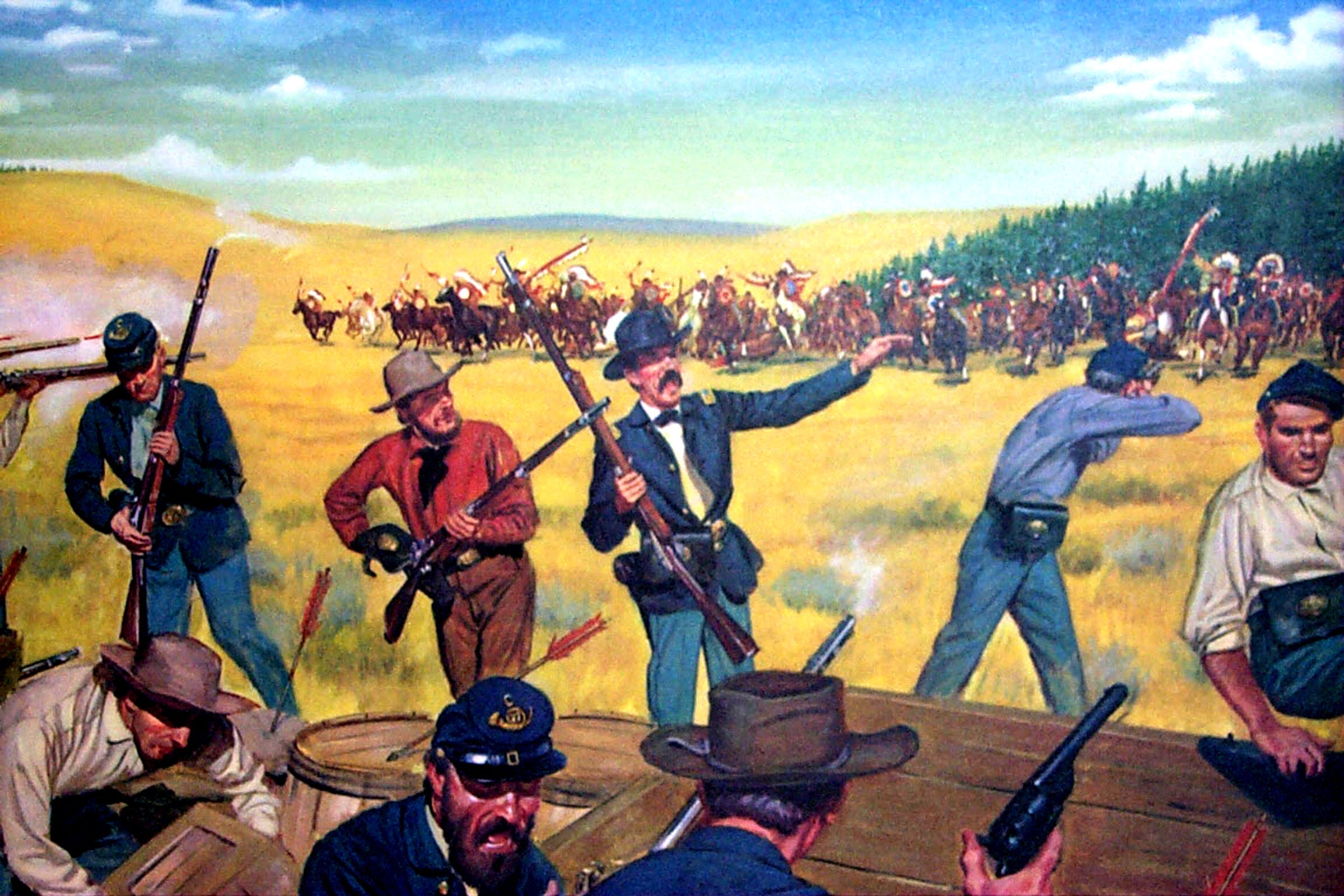
I have the honor to present for the information of the Post and Department Commanders a report of the engagement between a large body of hostile Indians, supposed to be Sioux Cheyennes and Arappahoes [sic], numbering at the lowest estimate three thousand (3,000) men, and part of my Company (C.27th Infantry) consisting of twenty-six enlisted men four civilians and two Officers (myself included), which occurred near Piney Island, five miles from this post, on the 2d day of August 1867.
On the 31st day of July 1867 pursuant to Special Order No. 128, bearing date July 31st, 1867, I left this post with fifty one (51) enlisted men and one (1) Officer, for the purpose of escorting and furnishing details to protect the laboring parties engaged by contractor J. R. Porter in hauling fuel to the Post. Upon my arrival at the above named place I found the train divided; one part encamped on a plateau, and with one exception, the position well selected for defence [sic], and the best security that the country afforded for the stock; the other part was encamped about one mile distant in a south westerly direction, on a commanding point across the Little Piney Creek, at the foot of the [Bighorn] Mountains. My details consisted in sending twelve (12) men to protect the working parties of both trains and thirteen (13) men as escort to the trains when coming into the post.
On the morning in question I had made the usual details, which left the twenty six (26) men, four (4) citizens and one (1) Officer above mentioned at my disposal.
About 9 o’clock in the morning two hundred (200) Indians attacked the herders in charge of the herd, driving them back off; at the same time some five hundred (500) attacked the train at the foot of the Mountains, driving off the men belonging there and burning it. Some fifteen minutes afterwards I was surrounded by about eight hundred (800) mounted Indians, but owing to the very effective fire of my small party they were driven back with considerable loss. Finding they could not enter the corral they retired to a hill about six hundred (600) yards distant and there stripped for more determined fighting; then with additional reinforcements continued to charge on foot for three consecutive hours, but were each time repulsed.
The hills in the immediate vicinity were covered with Indians who merely acted as spectators, until they saw how fruitless were the efforts of their comrades near my corral when they also moved up and seemed determined to carry my position at all hazards and massacre my command, which they undoubtably would have done but that Pvt. Lieut. Col. Benjamin F. Smith Major 27th U. S. Inft. was seen approaching with reinforcements when they retired, leaving some of their dead and wounded near the corral, thus closing the fight about half past twelve (12 1/2) o’clock P. M.
In my opinion there were not less than sixty (60) Indians killed on the spot, and one hundred and twenty (120) severely wounded, although the citizens who took part in the action are of the opinion that my estimate is far below the actual figures.
The following is a list of the casualties at my corral.
Killed
1 Lieutenant John C. Jenness, 27th U. S. Infantry
Private Thomas C. Doyle
” Thomas Haggerty
” Horace Kittridge Killed while escaping from the other corral
” Hermann Lang Killed while escaping from the other corral
” George W. Haines
Wounded
Private Nelson W. Demming Co C 27th Inft., shoulder
” John L. Somers, Thigh
That we escaped with such a comparatively small loss considering the large number operating against us, and their being so well provided with carbines and other breech loading arms, is due in a very great measure to the gallantry and coolness displayed by the men of my command together with their excellent marksmanship. In the death of Lieutenant Jenness the service has lost a gallant and promising young officer, one who had endeared himself to his comrades and who on the morning of his death fell while setting a noble example of coolness and daring to those who were serving with him.
I am Sir
Very Respectfully
Your Ob’d’t Servant
James Powell
Captain Co. C. 27th Infantry,
Brevet Major, U. S. A.
Commanding Company
The Powell Project, where I got the above, has something you could close a miniseries with. No longer a Brevet Major, back to Captain.
Fort Philip Kearney
August 4th 1867
To the Asst Adjt Genl
Department of the Platte
Omaha Neb
Sir,
I have the honor to apply for a leave of absence for ninety (90) days. Commencing on the 1st of October or November next-; for the purpose of visiting my family and attending to some [illegible] matters which they cannot possibly settle without my presence.
I have not had a leave of absence for several years and in the event of this application being granted my company would still have a commissioned officer on duty with it.
I am Sir
Very Respectfully
Your Obdt Svt
James Powell
Captain “C” Co 27 U.S. Inftry
The man saw a lot of war. It was time to come home. I can appreciate that.
He lived another 26 years, dying at age 71 in Peoria, Illinois. You can visit him at the Springfield Cemetery if you’re there.
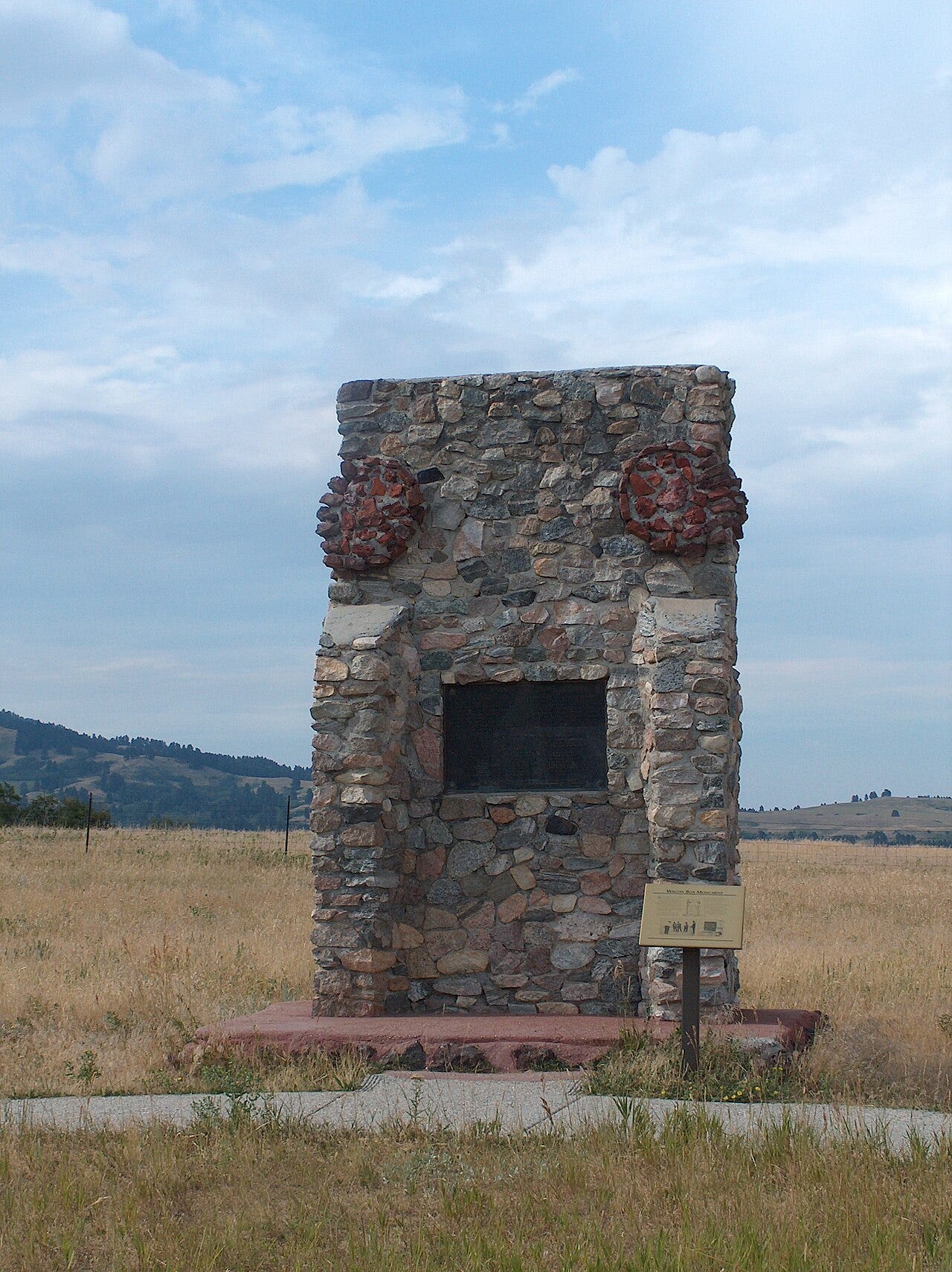
What about the men he fought with on that day? If you ever find yourself on Interstate 90 between Casper, Wyoming and Billings, Montana—perhaps coming back from a bike weekend in Sturgis, South Dakota—take a moment to hop off I-90 and head west on Highway 90 for about a mile, and then take a left on Wagon Box Road. The monument is only a dozen minutes or so off the interstate.
I think they earned a visit.
Final note: what does this have to do with ‘Ole Sal? Well, as regulars know, multiple lines of my family fought through the entire U.S. Civil War with Company C of the 7th Mississippi Infantry. They fought from Shiloh all the way until the final surrender in North Carolina.
They were all in the Atlanta Campaign and fought opposite James Powell in many of those battles. In the Battle of Jonesboro, I’ve always liked this quote from Captain D. Stanton Bruch from our sister company, Company E, at the close of action of the 7th Mississippi on 31 August, 1864. You can find the quote in Volume 2 of my signed edition of Ron Skellie’s, Lest We Forget: The Immortal 7th Mississippi Infantry Regiment.
Atlanta evacuated. Health of company good, casualties heavy. First we win at the railroad cut, then we retreat, then we attack at Lickskillet and Ezra Church and we get whipped, then we survive a month in red clay ditches to get beat at Jonesboro and now we hear Atlanta’s lost and “smart men” call it an evacuation. I do know that for those who are still alive our health is good, but for those ‘heavy casualties’ theres ain’t so good. What I do know is the report should say…Atlanta falls-enuff said-let’s go!
My direct Great-Great Grandfather was, like me, a recidivist staff weenie and spent most of the war on General Joseph E. Johnston’s staff and survived the war…and there are stories from his time my family knows that perhaps best left to be told over drinks.
No need to belittle your ancestor for serving on the staff of one of the better generals of the CSA. Now if it had been on the staff of Ben Butler or Ambrose Burnside…
Moon of the Bitter Cold is a pretty good tale of the Fetterman Massacre, Bozeman Trail, Fort Phil Kearny, Red Cloud, etc.