
Fullbore Friday
...the best of his generation...

One thing my father taught me at an early age was to treat everyone you meet with respect. You never know someone else’s story. You never know what fate has in store for them.
The old man with an oxygen tank sitting on a bench outside the commissary. The young JROTC cadet from the family at the end of the street. The guy you bump into while getting another cup of coffee at the VA.
Respect.
You just never know. “Show them the proper respect.” … that is what I hear in my father’s voice in my head, though he never really had to say it. Just a look was sufficient.
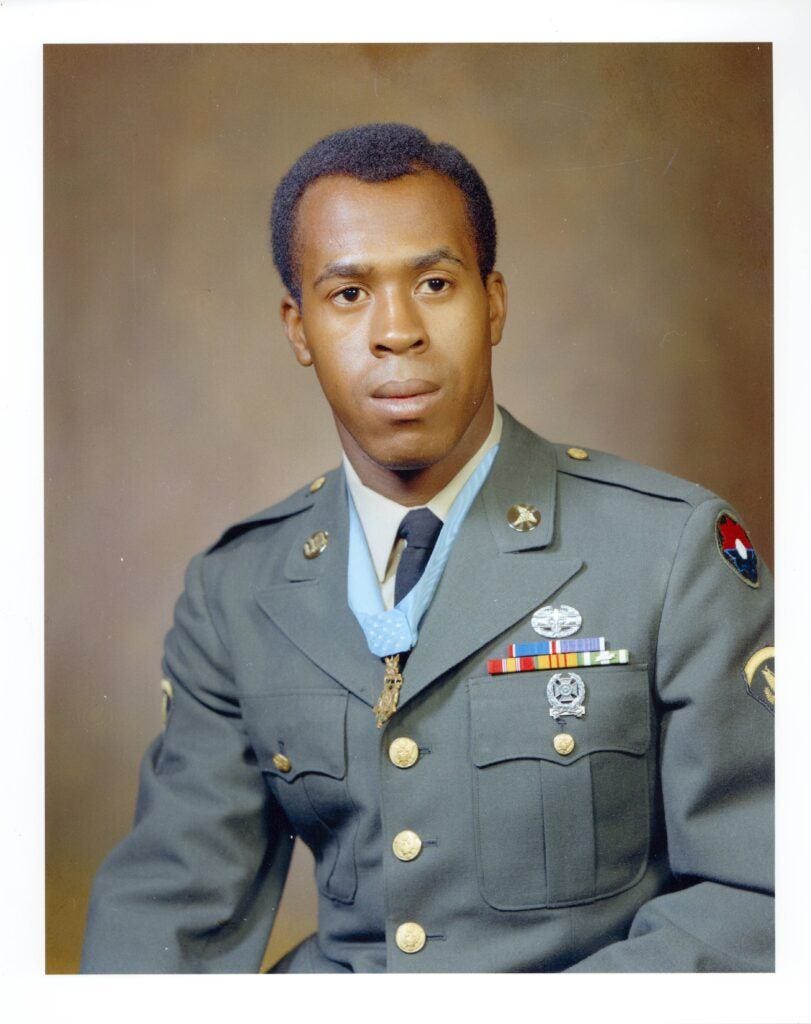
Every time I hear another story about people like Clarence Sasser, I’m reminded of how my father insisted I live my life, treating everyone I met with respect. Imagine how many people Sasser ran in to in the course of a work week who had no idea what he had done as a young man. He’s an everyman, but he’s Superman.
I wish I knew Sasser’s story before he passed in May of 2024.
Clarence E. Sasser, a former U.S. Army combat medic, former student of Texas A&M University and longtime employee of the Department of Veterans Affairs, died Monday at the age of 76.
Born Sept. 12, 1947, in the small community of Chenango, Texas, south of Houston, Sasser served with distinction during the Vietnam War, becoming one of only eight Aggies to earn the Congressional Medal of Honor — the nation’s highest military decoration. Sasser is the only former student to earn a Medal of Honor during that conflict, making him the most recent Aggie Medal of Honor recipient and the last living recipient prior to his death on May 13. His name is enshrined in the Memorial Student Center’s Medal of Honor Hall of Honor on the Texas A&M campus alongside seven other Aggies, all of whom fought in World War II.
“I’m an Aggie at heart — always have been and always will be,” Sasser said in 2013 during his Hall of Honor recognition ceremony.
In Vietnam, Sasser served as a medical aidman in the Army’s 60th Infantry Regiment. His tour of duty lasted just 51 days. During a reconnaissance operation in Dinh Tuong Province on Jan. 10, 1968, he and his unit came under heavy attack from enemy forces, sustaining more than 30 casualties within the first few minutes of fighting. Amid the barrage of bullets and rocket fire, Sasser sprinted across an open rice field to render aid to the wounded, continuing to assist his fellow soldiers even after suffering a wound to his left shoulder from a mortar strike.
…
One year later, he was presented with the Medal of Honor by then-President Richard Nixon and was personally offered a scholarship to Texas A&M by university president and fellow Army veteran James Earl Rudder. Having previously studied chemistry at the University of Houston, Sasser elected to continue those studies at A&M, enrolling as a chemistry major in August of 1969. Soon after, he married Ethel Morant and went to work for a Houston-area oil refinery before taking a job with the VA, where he worked until his retirement.
Attention to Citation
For conspicuous gallantry and intrepidity in action at the risk of his life above and beyond the call of duty. Sp5c. Sasser distinguished himself while assigned to Headquarters and Headquarters Company, 3d Battalion. He was serving as a medical aidman with Company A, 3d Battalion, on a reconnaissance-in-force operation. His company was making an air assault when suddenly it was taken under heavy small-arms, recoilless-rifle, machine-gun, and rocket fire from well-fortified enemy positions on three sides of the landing zone. During the first few minutes, over 30 casualties were sustained. Without hesitation, Sp5c. Sasser ran across an open rice paddy through a hail of fire to assist the wounded. After helping one man to safety, he was painfully wounded in the left shoulder by fragments of an exploding rocket. Refusing medical attention, he ran through a barrage of rocket and automatic-weapons fire to aid casualties of the initial attack and, after giving them urgently needed treatment, continued to search for other wounded. Despite two additional wounds immobilizing his legs, he dragged himself through the mud toward another soldier 100 meters away. Although in agonizing pain and faint from loss of blood, Sp5c. Sasser reached the man, treated him, and proceeded on to encourage another group of soldiers to crawl 200 meters to relative safety. There he attended their wounds for five hours until they were evacuated. Sp5c. Sasser’s extraordinary heroism is in keeping with the highest traditions of the military service and reflect great credit upon himself, his unit, and the U.S. Army.
Take a moment to hear Sasser in the first person.
Fullbore.
These stories are healthy reminders that the real hero’s are not in Hollywood and they are not Athletes.
These are always a highlight of the week. Inspiration and good for us all.
We tell hero stories like this to know that we are capable of more, and that great people have walked among us.