

Life comes at you fast; you better be ready for it.
We are coming up on three years from the final wakeup call after October 7th, 2023, that conventionally armed ballistic missiles are the premier threat to critical capabilities ashore and at sea.
In the U.S. at least, though production was minimal and inventories allowed to be too small, we at least had the technology to meet the threat from Medium, Intermediate, and Intercontinental Ballistic Missiles.
At sea, which will be our focus today, we just made it across the finish line in time with the RIM-161 SM-3, which built off the success of the iterative development of the SM-2 for decades.
This work has paid off via the exceptional performance of our Arleigh Burke Class destroyers off Israel, and in defending our fleet from the Red Sea to the Arabian Sea against Iran and her proxies.
With each engagement, our software gets better…the next update to our missiles gets better, and, more importantly, it has yanked the Lotus off the dinner plate of our defense establishment to expand production and inventories.
Bravo Zulu to those people who fought, mostly nameless and unseen, for decades to ensure we did not take our eye off the need to be able to meet the threat from ballistic missiles.
Here’s the issue. We’re alone here, and our European allies just don’t seem to get it. Their historical passivity in this area is why a decade and a half ago the U.S.A. deployed inside the NATO framework Aegis Ashore installations—one in Deveselu, Romania and one in Redzikowo, Poland—and the American Arleigh Burke DDG based out of Rota, Spain.
Classic NATO: “The Americans will do it. Let increase aid for foreign NGOs instead.”
Some minds are turning in the right direction, as there are some moves from The Netherlands and perhaps Germany and Denmark, who are pondering the possibility of getting SM-3 at some point in the future.
That is a lot of appreciating the problem, fitting-for-but-not-equipped-with kind of thinking, but the fact remains that at this moment and at any time in the near future, no European NATO navy has a capability even approaching the SM-3.
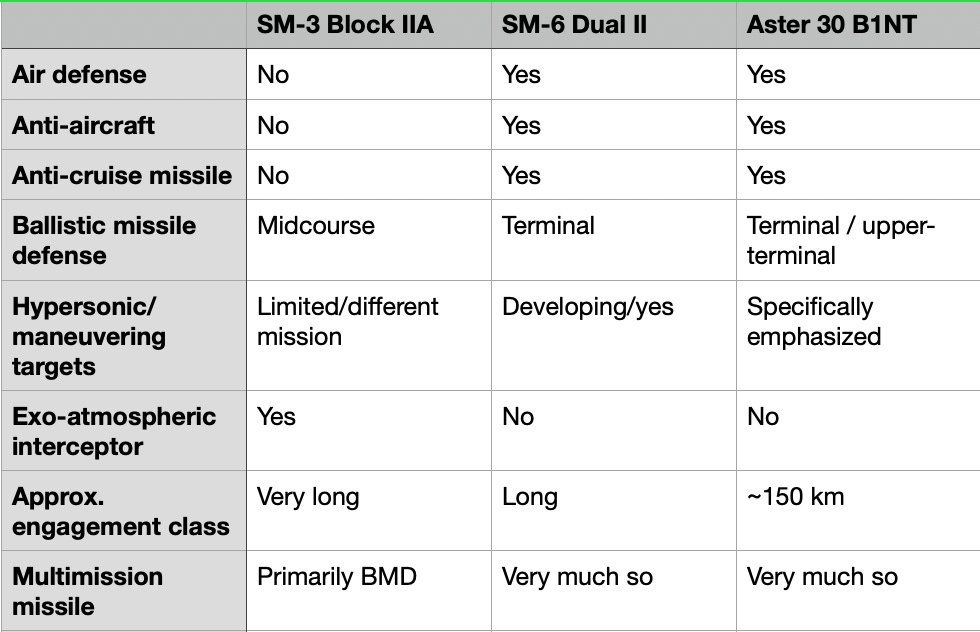
Range and reach. The SM-3’s range is well past 1,000km and more importantly, it can intercept missiles outside the atmosphere—exo-atmospheric.
Nothing else at sea in the West can do this. The closest the Europeans have is the French Aster 30 B1NT, which we can expect the French Navy, Italian Navy, Royal Navy, and Swedish Navy to equip their ships with.
On paper, it is an exceptional capability, but it is much closer in capability to the SM-6.
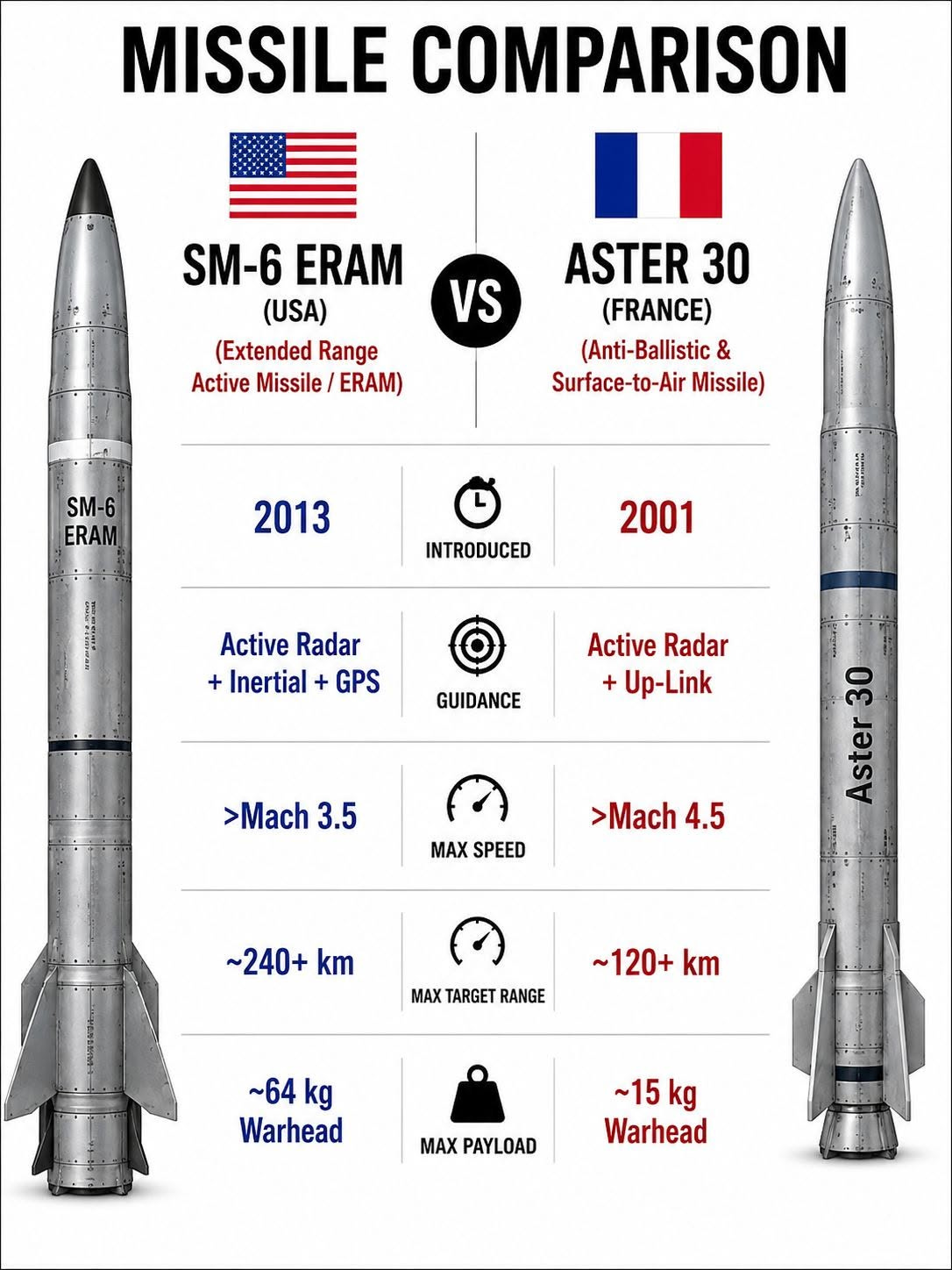
Both of these can do anti-ballistic missile (ABM) work, but only endo-atmospheric. Here’s a quick comparison of the three I threw together. I think I have things correct here. If not, let me know otherwise in the comments.
As wretchardthecat pointed out on X, I believe, correctly,
Consider the French Charles de Gaulle. A normal CdG group includes at least one Horizon-class air-defence frigate. It has no SM-3 equivalent. It has no dedicated exo-atmospheric interceptor.
British Queen Elizabeth carriers are organically defenseless against an Iranian antiship attack. Everything depends on Type 45 escort which has the same capability as the French Horizons.
Either ship might withstand a light attack but probably lack the capability to survive against the volume of fire the USN took.
He then, rightfully, points out that there is a navy out there besides the U.S. Navy that does have the capability that the SM-3 has—the Japanese Navy—and they have been at it for almost a decade.
The yet-to-be-named cruisers they are building now will be superb ABM platforms. They just need to expand the run past two ships.
South Korea plans to get 20 to 30 SM-3s for its next Aegis destroyers, and I would bet that buy will expand as well.
So, the U.S. does have allies that are getting ready for today’s and tomorrow’s threat from ballistic missiles…but European NATO?
A little thin, and relying on Uncle Sam, who—should he find himself in a fight with the PRC west of the International Date Line—will have higher and better uses for his ABM capabilities than parking them in Europe.
Speaking of thin, effectively large portions of the world’s oceans are now off limits for the few aircraft carriers the Europeans have. There is always risk, as you will have leakers in any determined attack—but unless those European strike groups have an SM-3 equipped ships with them, the risk is simply too great.
They are already late and behind. Someone needs to light a flame under their sterns.
It's ADORABLE that Britain and France think they have a real navy!
Make a requirement that they have the people and hardware capable of being team player to have membership in the NATO alliance. Can't meet the cut? You get removed from the umbrella. You don't even get a seat on the bench. Let the grifters fend for themselves. If NATO withers and dies, so be it.