
Surface Drones...More Faster, Please
less problem appreciation, more steel cutting

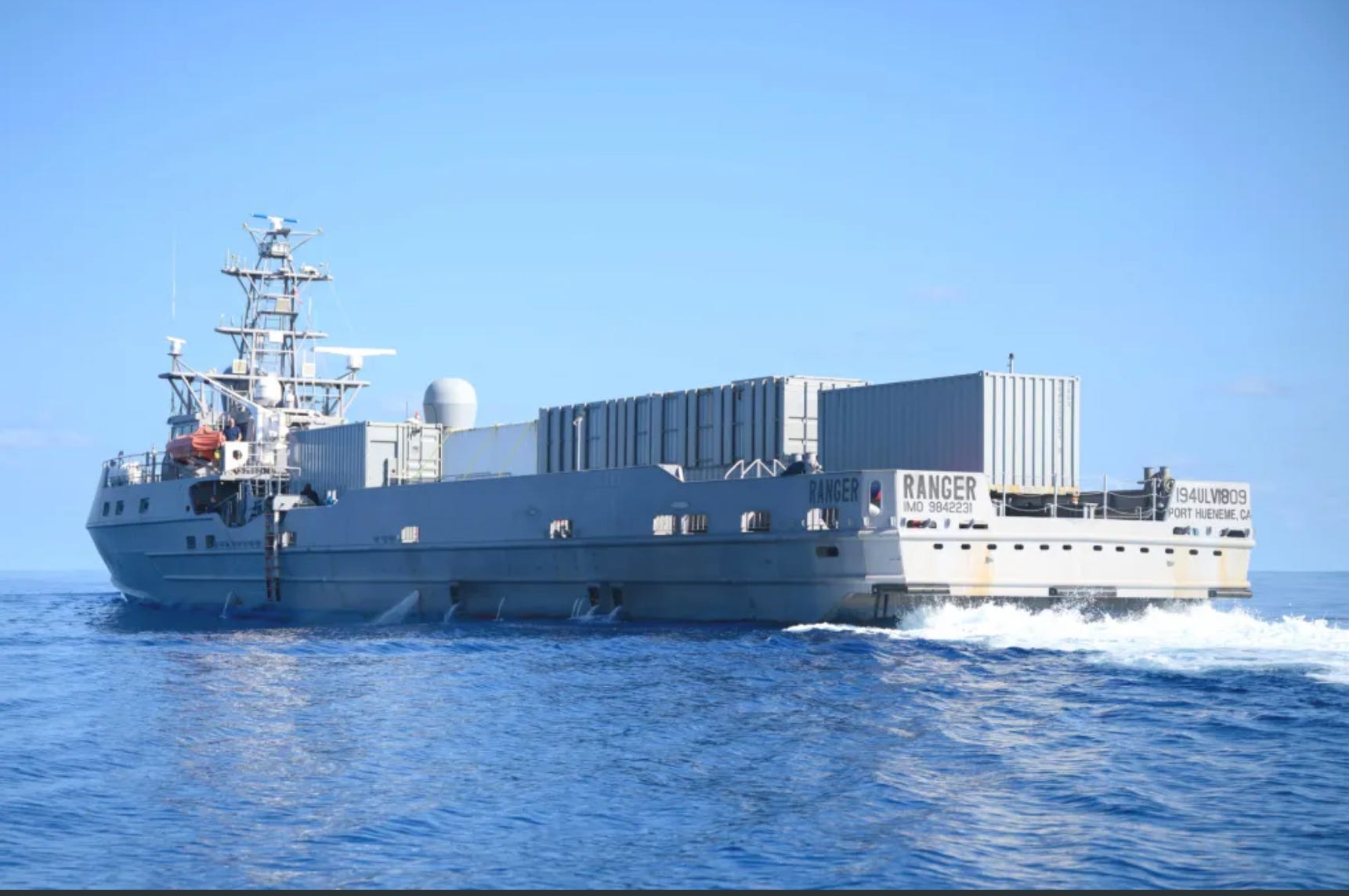
Sadly, not everyone subscribes to the Midrats Podcast, I wanted to build off part of yesterday’s podcast on the latest developments in the US Navy’s drone programs.
My big takeaway is that the surface force—and the subsurface drone programs as well—are not going to (or more likely be allowed to) repeat the same mistake for our Navy and the nation made when the pointy-nosed people at NAVAIR killed the promise that was the X-47B a dozen years ago.
Though my desire is for ‘more faster’, when I take a deep breath and step back, on balance, this leaves me quite happy with the plan.
Joseph Trevithick over at TWZ has a great summary of the state of play.
The Naval Sea Systems Command (NAVSEA) laid out requirements for three USV types under the MASC umbrella in a contracting notice earlier this week.
…
The Modular Surface Attack Craft (MASC) contracting notice that NAVSEA put out this week calls for three designs – a baseline version, as well as high-capacity and single-payload types – the requirements for which are all based around payload capacity, range, and speed, rather than length and/or displacement.
“The desired [baseline MASC] vessel solution should carry a minimum of two forty-foot equivalent unit (FEU) containerized payloads that weigh 36.3 metric tons (MT) each and consume up to 75 kilowatts (kW) each,” the notice says. “While carrying 25 MT on the payload deck, the vessel should achieve a minimum range of 2,500 nautical miles (nmi) while maintaining at least 25 knots, at all times, in NATO Sea State 4.”
…NAVSEA’s recent MASC contracting notice says. “The desired vessel solution should have the ability to carry a minimum of four (4) FEUs containerized payloads that weigh 36.3 MT each and consume up to 50 kW each. The technology solution should maximize speed and range to the extent practicable.”
…
The contracting notice also lays out additional “highly desired,” “strongly desired,” and “other desired” attributes that are more broadly applicable.
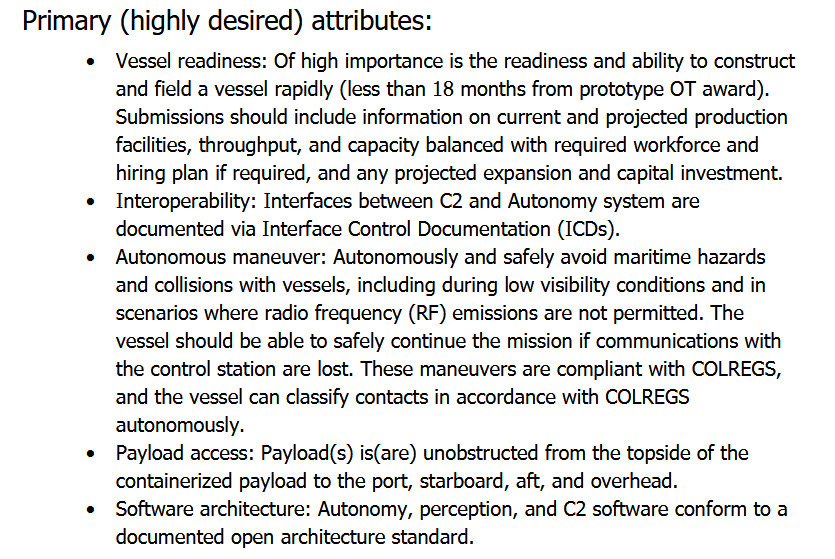
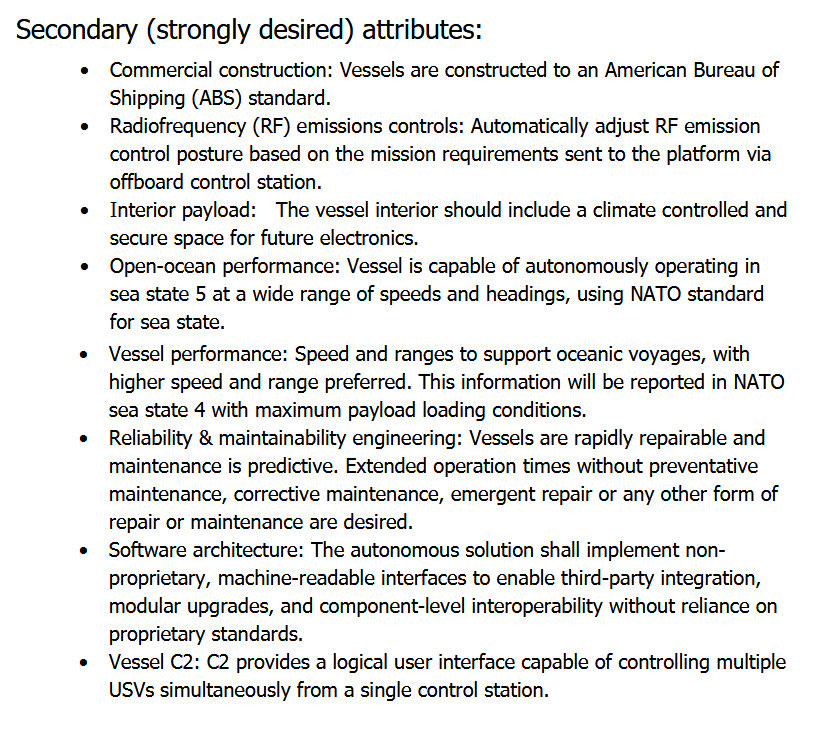
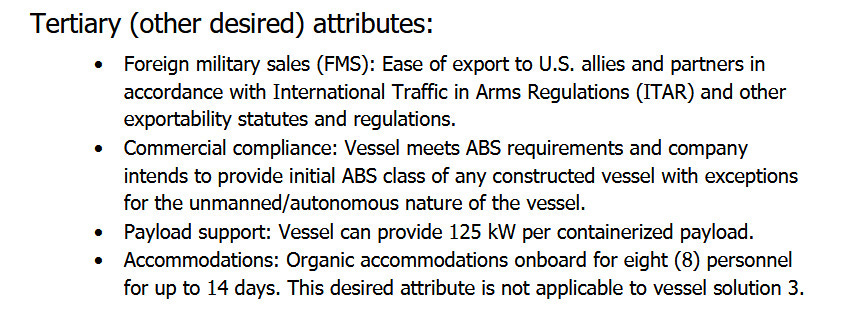
Read Joseph’s full article for the details, but when I see the above, combined with what I know we are learning from DARPA’s USX-1 Defiant, Manta Ray, and Boeing’s XLUUV, we appear to be following the proven path of ‘build a little, test a little, learn a lot’ that gave us Aegis and other successful programs.
18-months from award to displacing water? Again, more-faster…but let’s go.
Get them to the fleet. Let Strike Group Commanders ponder their utility. Let Sailors work on and with them. Let’s find out what we got right, what we got wrong, and what surprises are out there we need to fix, sooner rather than later.
Do that, process the lessons, and then move quickly to Flight II by leveraging what works, leaving behind what does not.
My worry?
The PLAN will sit back and watch us iterate and develop, then steal the plans for the best version and out produce us by a factor of 20
I like it. Is this of a size commercial shipyards (not the usual NG / BIW) could support? Certainly helps with finding qualified seaman! OBTW, any confidence that the same systemic / NAVSEA management deficiencies that have wrecked or terminally delayed all recent major system acquisitions have been corrected? Is public excu....firing a realistic option? (mostly kidding...)