
Wait...We Don't Have to Give up on the Railgun?
...still my beating heart...

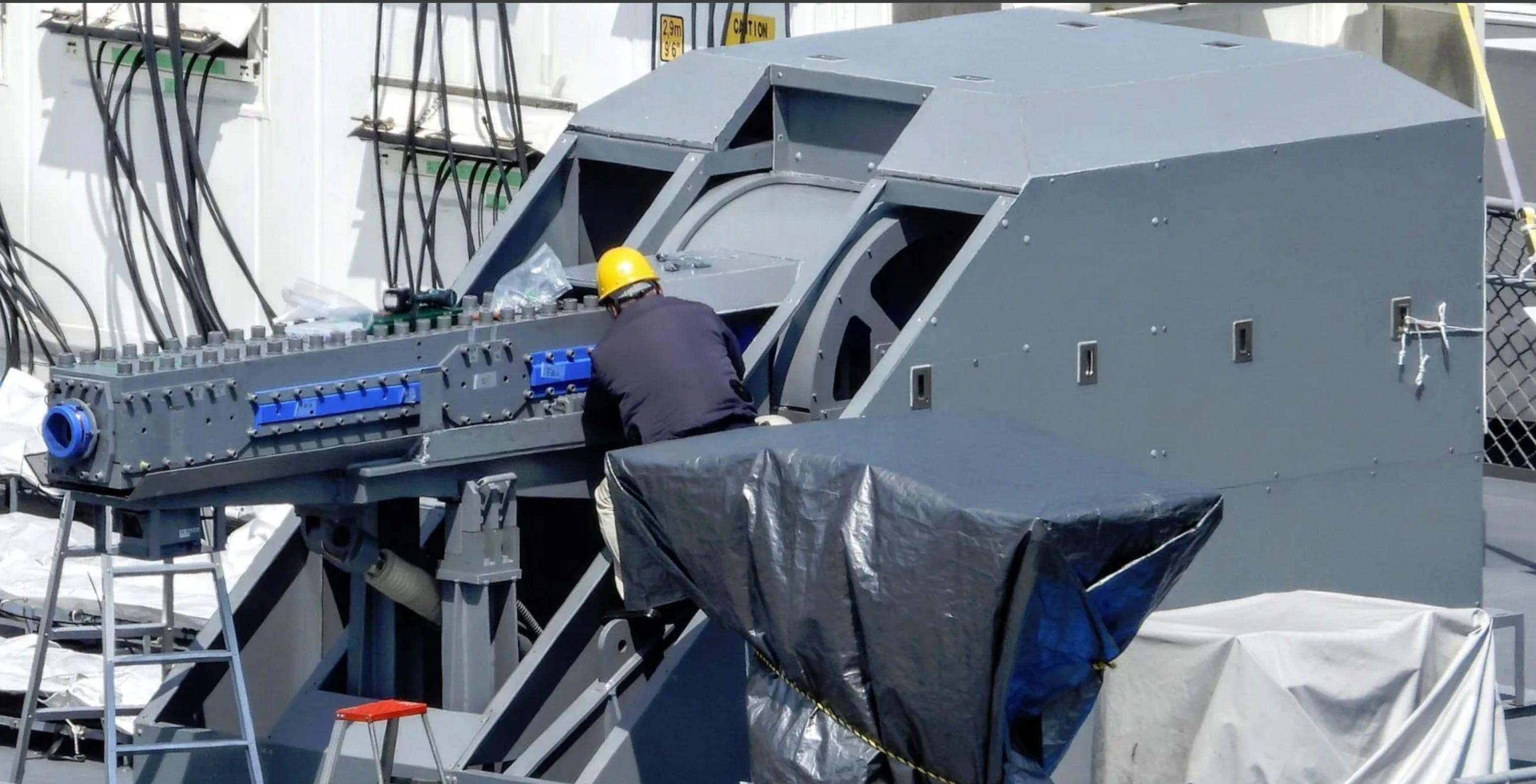
Oh, my love and forlorn desire has appeared before me once again to cause me to hope and to think of what might have been.
Alas, as with many things you crave too much but never capture, over the years you feel cheated, heartbroken, and perhaps a little bitter…but still, you long for the promise always right out of reach.
The railgun.
Directly, I first wrote about it on the OG Blog almost fifteen years ago, and indirectly over fifteen years ago. Let’s visit when I addressed it directly:
With the advances of technology, computers, and a better understanding of what it takes to destroy a missile in flight - in 15 years and utility and effectiveness of the missile as an offensive weapon might come under significant risk. When you think about it - a missile is a very fragile thing.
A gun round designed to go from 0 to Mach 7 in just a few meters? That is a little tougher to kill.
From Gun to Missile to Gun. A new era for a primary weapon perhaps? The gun never left us of course ... but could she regain her top billing?
Keep the transformationalists away from the program - don't over sell it - and follow the best practices of the 1950-60s missile programs in rolling out the new weapon. If we do that, I think we might have something here. The fundamentals of war at sea and projection of power ashore will remain the same - just how you do it will change.With the advances of technology, computers, and a better understanding of what it takes to destroy a missile in flight - in 15 years and utility and effectiveness of the missile as an offensive weapon might come under significant risk. When you think about it - a missile is a very fragile thing.
A gun round designed to go from 0 to Mach 7 in just a few meters? That is a little tougher to kill.
From Gun to Missile to Gun. A new era for a primary weapon perhaps? The gun never left us of course ... but could she regain her top billing?
Keep the transformationalists away from the program - don't over sell it - and follow the best practices of the 1950-60s missile programs in rolling out the new weapon. If we do that, I think we might have something here. The fundamentals of war at sea and projection of power ashore will remain the same - just how you do it will change.
I have been writing for so long that the “distant future” is, well, now. When I wrote the above in 2010, I referenced progress in 15 years, the same length of time from today to 2040.
Well, at least I got the vulnerability of missiles correct. Just look at the performance of the US Navy and Army, along with their Israeli counterparts, against Iranian ballistic missiles over the last few years at sea and ashore.
However…the railgun remains just a mirage.
Though we punted, we know the Chinese are giving it a shot.
Can the Japanese make it happen? Well, let’s check in with Joseph Trevithick at TWZ:
New pictures have emerged showing work being done on the Japan Self-Defense Forces’ prototype electromagnetic railgun currently installed on the test warship JS Asuka. An at-sea test of the weapon in this configuration is expected to come before the end of the month, if it has not occurred already. Japan’s continued developments in this realm stand in notable contrast to the U.S. Navy’s shelving of its promising pursuit of this category of weapons in the early 2020s after major technical hurdles emerged.
The images of Asuka and its railgun in port in Yokosuka, seen at the top of this story and below, come from @HNlEHupY4Nr6hRM on X who originally posted online. All of the images were taken on June 30. Additional photos of the ship taken recently are also circulating online. Asuka, a 6,200-ton-displacement dedicated testbed with a warship-like design, first emerged with the turreted railgun on its stern flight deck in April.
Crawl, walk, run?
In past testing, ATLA has reportedly demonstrated the ability to fire rounds at a velocity of around 4,988 miles per hour (2,230 meters per second; Mach 6.5) while using five megajoules (MJ), or 5 million joules (J), of charge energy. As of April, prior testing goals had included a muzzle velocity of at least 4,473 miles-per-hour (2,000 meters-per-second) and a barrel life of 120 rounds, according to Naval News. Reports say that ATLA has also been working to reduce the weapon’s power requirements.
Build a little. Test a little. Learn a lot.
In May, Aviation Week reported that at least one at-sea test of Asuka‘s railgun installation was set to occur sometime in June. Yahoo Japan subsequently published a story saying that the testing window would span from June 9 to July 25. That same piece said that the test ship had been observed departing Yokosuka on June 9, but it is unclear whether or not any live-fire testing has yet taken place.
Speaking through an interpreter at a panel discussion at DSEI Japan 2025, Kazumi Ito, principal director of the equipment policy division at ATLA, said Japan’s railgun efforts were “progressing,” but acknowledged “various challenges,” according to National Defense Magazine.
I’ve looked around but haven’t seen anything yet. If you have, put it in comments.
I like Christian Orr’s thinking here four days ago:
Digging further, we learn from an article by James Keller of Task & Purpose that the USN’s railgun program was officially declared dead in July 2021 “in light of ‘fiscal constraints, combat system integration challenges and the prospective technology maturation of other weapon concepts,’ according to a statement provided to Military.com.”
The US Navy’s researchers spent 15 years and $500 million on research and testing. Yet, they were unable to solve the vexing problems that their Japanese counterparts had solved in less than half the time and with just over 1 percent of the amount of money spent.
Perhaps the USN will be able to apply lessons learned from their Japanese counterparts and pool resources to develop railguns as a joint venture going forward.
Another technical challenge of railgun technology that has yet to be overcome is that they require an enormous power supply—to the tune of a million or so amperes of current—making the portability of railguns a daunting prospect.
OK, we can add this to the list with the ShinMaywa US-2. The Japanese buy a lot of our national security kit. In addition to buying a couple-three dozen US-2, if the Japanese engineers have cracked a code, let them lead but with whatever money and intellectual help they need to make it better faster—and then buy it from them.
Will I be posting about railguns, the “weapon of tomorrow, and always will be” like this in 2040, 15 more years in the future, still heartbroken?
We’ll see—Lord willing and the Creek don’t rise.
thermoregulation of the barrels is one of the largest issues, the second being the lack of ambient temperature superconductors for capacitors. You can only fire modern railgun barrels but a few times before you warp the barrels and/or coils. the Q from the air friction from the round propelled down the barrel does what propellant nominally does to conventional guns. Ambient temperature superconductors and a novel cryogenic cooling schema--for the superconductors as well as for the barrels--would greatly extend the service life of the barrels as well as decrease the recharge time between shots. Another idea is to change the CONOPS--instead of STRIKE, consider shooting small, frangible / flak rounds against incoming targets. As Sal stated, consider the fragility of missiles. Destroying and/or damaging flight surfaces using flak traveling at mach 7 could do the trick right nicely.
Much the same story on laser weapons. I wrote a PSP paper at the War College on directed energy. I later had responsibility for a chemical laser effort in the Army. As a senior OSD person once told me, lasers have all the potential of Brazil-- and they always will. 20+ years later, the Army is once again on the cusp.