

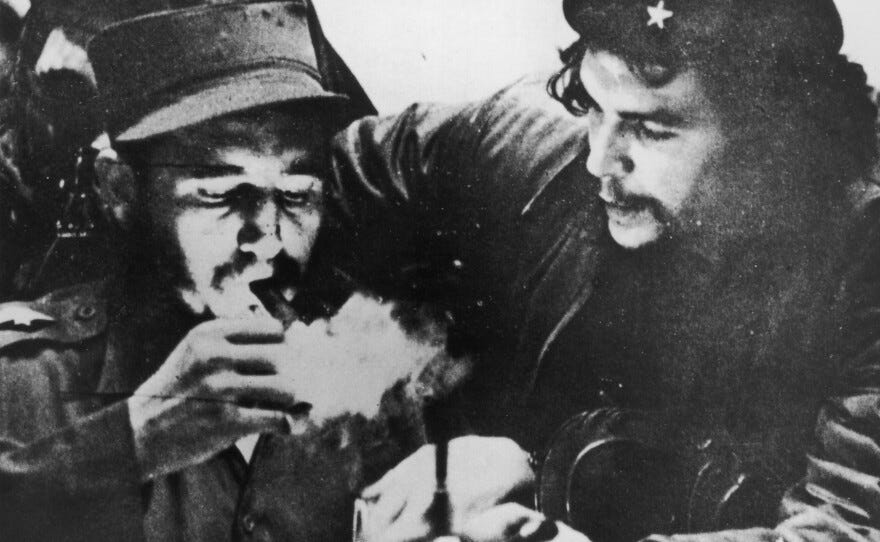
As regulars here know, there are two defining cultures that shaped who I am. First, both sides of my family are Old Line Southern families who have been in the South for four centuries. Second, I grew up in Florida with the children of Cuban and Iranian refugees. The former, especially, shaped my view of the greatest cancer on this planet in the last two centuries—Communism.
As a fellow Floridian of the same age, I just nodded and smiled when Secretary of State Marco Rubio's State Department published, Cuba: the Capital of 21st Century Communism.
It pulls it all together. It is a document that serves as a marker, a Ref. A, and a testament. I encourage you to put it on your read-list, but indulge me as I pick just a few things from it to share.
For nearly seven decades, the Cuban regime has waged a sustained campaign of subversion against the United States. It is a campaign that has infiltrated the highest reaches of the U.S. government, recruited and cultivated generations of American activists, backed an unprecedented wave of left-wing terrorism on American soil, and carried out one of the most durable and damaging foreign intelligence penetrations in American history.
… the most successful and enduring sphere of Cuba’s campaign against America has taken place on the ideological battlefront. Since the 1960s, the regime has served as the beating heart of a new and distinct kind of Marxism, forged around an overriding resentment and fundamental hatred of the United States and the broader West. The Cubans devoted themselves to recruiting, cultivating and mobilizing a global coalition of activists, intellectuals, and political groups around this cause, building a sprawling revolutionary network that shaped a disproportionate share of America’s most famous and influential extremist movements, from the Black Panthers and the Weather Underground through to Antifa. Today, that network continues to maintain ties to powerful leftist nonprofits, anti-ICE collectives, socialist groups, and Marxist militant organizations across the United States.
Literally my entire life.
In 1966, Castro convened the Tricontinental Conference. Among the organizations represented in the audience were the Palestine Liberation Organization, the Viet Cong, Puerto Rico’s leftist Pro-Independence Movement, South Africa’s African National Congress, and the Zimbabwe African People’s Union, whose guerillas – including cadres trained in Cuba – would join forces with ANC militants to carry the African revolution into Rhodesia the following year. The Tricontinental magazine that was born from the conference became a major global influence in its own right, publishing quarterly issues brimming with radical essays, poetry and art, which circulated to tens of thousands of readers across nearly 90 countries. For decades, Tricontinental was the most influential vehicle for the global iconography of “anti-imperialism”: its fold-out posters of Che, Ho, Lumumba and other Third World revolutionaries and its colorful “Yankee Out!” flyers passed through every New Left publisher, student group, bookstore, and organizing committee in the West. Three years later, the Venceremos Brigade was born. Over the next half-century, the Brigade would transport thousands of American radicals to the island to network with regime officials and receive “political education” in the principles of the Cuban Revolution. U.S. officials would soon learn that the program was dominated by Cuban spies, designed and run as a vehicle for Havana’s operatives to infiltrate and shape the American radical milieu.
All the usual suspects.
In 1966, Castro convened the Tricontinental Conference. Among the organizations represented in the audience were the Palestine Liberation Organization, the Viet Cong, Puerto Rico’s leftist Pro-Independence Movement, South Africa’s African National Congress, and the Zimbabwe African People’s Union, whose guerillas – including cadres trained in Cuba – would join forces with ANC militants to carry the African revolution into Rhodesia the following year. The Tricontinental magazine that was born from the conference became a major global influence in its own right, publishing quarterly issues brimming with radical essays, poetry and art, which circulated to tens of thousands of readers across nearly 90 countries. For decades, Tricontinental was the most influential vehicle for the global iconography of “anti-imperialism”: its fold-out posters of Che, Ho, Lumumba and other Third World revolutionaries and its colorful “Yankee Out!” flyers passed through every New Left publisher, student group, bookstore, and organizing committee in the West. Three years later, the Venceremos Brigade was born. Over the next half-century, the Brigade would transport thousands of American radicals to the island to network with regime officials and receive “political education” in the principles of the Cuban Revolution. U.S. officials would soon learn that the program was dominated by Cuban spies, designed and run as a vehicle for Havana’s operatives to infiltrate and shape the American radical milieu.
I’ve mentioned a few times why in the late 1970s my family left the Presbyterian Church—a church we have been members of for centuries back to before we were kicked out of Scotland—because every Sunday became a Nicaraguan communist rally. My dad was right about two things: 1) Leave the church. 2) Don’t buy the coffee plantation and move the family to Costa Rica.
That movement also benefited from its integration into Cuba’s broader proxy network. That network spanned the hemisphere, working through third countries, sympathetic governments, guerilla cells, clandestine networks, and transnational leftist organizations that could move soldiers, weapons, money, and messages across Latin America. (And beyond – via the Cubans, the Sandinistas were introduced to militants from the PLO, and reportedly traveled to the Middle East to receive training in PLO camps there).6 In the final phase of the Nicaraguan struggle, the Sandinistas were not simply a local insurgency. They were the beneficiary of a hemispheric revolutionary supply chain, drawing on an expansive cast of Latin American allies, militants, and fellow travelers, all operating inside the political and logistical space that Havana had spent two decades building. By 1979, Cuba was reportedly sending trained guerrillas back into Nicaragua, supplying heavy weapons, and possibly even inserting its own Cuban specialists, as well as organizing, arming, and transporting an “internationalist brigade” of militants from several Central and South American extremist groups to fight alongside the FSLN.
Anyone who deployed/were stationed/took liberty to Puerto Rico in the 1980s and 90s knew the brief.
Puerto Rican revolutionaries were a source of particular interest for Castro’s regime. So much so, in fact, that large shares of the entire movement were effectively built by Cuban intelligence services – “created,” as one 1999 Los Angeles Times report put it, “in consultation with Cuban intelligence agents.” ... The guerilla group proved to be the most active and deadly domestic terrorist organization of its day, carrying out as many as 130 bombings between 1974 22 and 1983. ... In 1979, a cell of AK-47-wielding Macheteros militants staged an armed ambush of a U.S. Navy bus, killing two sailors and wounding nine others. Less than three years later, a Macheteros ambush on four sailors from the U.S.S. Pensacola claimed another American life. …When the Macheteros fired an anti-tank rocket at the building housing the FBI San Juan headquarters in 1983, they used U.S. military hardware that had been captured in Vietnam and subsequently shipped to Cuba. The same Havana-supplied weaponry was used two years later in the Macheteros rocket attack on a U.S. courthouse in San Juan that housed the U.S. Marshals Service and other federal agencies. In another instance, the Macheteros militant Víctor Manuel Gerena – who holds the record for the longest-ever stint on the FBI’s Top Ten Wanted Fugitives list – led the armed robbery of more than $7 million from a Wells Fargo depot in 1983, hog-tying and drugging a bank worker by jabbing a needle in his neck.
It is so good that all of this has been put together in one document to make official what most of us in Florida knew to be true, if only because of our proximity.
By the mid-1980s, Latin America was the site of more acts of international terrorism against U.S. targets than any other region in the world, largely driven by at least two dozen Cuban-backed Marxist groups. Late-1980s estimates reported that Cuba had “worked quietly to train, build up, and unify” some 27 leftist guerilla groups across the region, totaling about “25,000 armed and trained members” in total. In 1986, Latin America accounted for about 55 percent of all incidents of terrorism involving U.S. targets. By 1989, it accounted for an estimated 64 percent. Cuba’s revolutionary ambitions were not confined to the Western Hemisphere. Starting in the early 1960s, the regime set up a network of training facilities around Havana that taught tens of thousands of militants from Latin America, Africa, the Middle East, and eventually North America how to handle weapons, prepare explosives, and carry out urban guerrilla tactics. In the first three decades of the Castro regime, at least 20,000 guerillas from “virtually every Latin American nation” had attended terrorist training camps in Cuba. From the mid-1970s to the mid1980s, another 20,000 people from around the world traveled to the island to undergo revolutionary “education” at Cuba’s Isle of Youth complex.
The Cubans were not just concerned with the 3rd World.
What was Venceremos?
The Venceremos Brigade – described in one Senate report as among “the most extensive and dangerous infiltration operations ever undertaken by a foreign power against the United States” – has brought some 10,000 American activists to Cuba since its first contingent in 1969. Its participants have included well-known elected officials, labor leaders, academics, activists, and a long list of other influential U.S. progressives. Since its creation, the Brigade has served as a tool for the Cuban regime to sponsor a wide range of subversive activities against the United States – ranging from influence campaigns to espionage and guerilla violence. It has been linked to the formation of some of the most infamous far-left terrorist movements in U.S. history. The first Venceremos Brigade – born out of a 1969 meeting between Cuban officials and radical American students – came at a moment when America’s emerging New Left was undergoing a shift away from campus activism and toward revolutionary violence. Many members of the first 216-person contingent that traveled to Cuba that year hailed from the faction of America’s radical left that would lead that transition. Several of the young American organizers of the first Brigade were also in the midst of forming what would come to be known as the Weather Underground. The revolutionary leftist group was born in 1969 – the same year as the Brigade – when the radical “Weatherman” faction split off from the collapsing Students for a Democratic Society (SDS) at the national SDS convention. From the outset, they maintained a close relationship with the Cubans.
FBI reporting relayed that the Weather Underground had “initiated, planned and organized the Venceremos Brigade (VB) trips” with the direct “encouragement and instructions of the Cuban government.”
The next year, the Weathermen issued a “Declaration of War” against the U.S. government, and launched an unprecedented campaign of terrorist attacks across the United States, bombing targets such as the U.S. Senate, the State Department, and the Pentagon. Some of the organization’s members would carry that revolutionary war into the 1980s, allying with militant communist and black extremist groups to bomb U.S. military bases, execute prison breaks, and assassinate police officers.
This is not ancient history.
Fomenting a revolution within the United States has always been an explicit ambition of Cuban programs like the Venceremos Brigade.
…
In 1995, Barack Obama launched his first-ever run for political office in the living room of Dohrn and her husband, Bill Ayers – another co-founder of the Weather Underground who would go on to become Professor of Education at University of Illinois at Chicago. Dohrn was hardly the only former Venceremos radical to transition into mainstream power. Susan Rosenberg is a Brigade alumna who later joined the May 19th Communist Organization, a particularly violent terrorist offshoot of the Weather Underground that was responsible for the murder of two police officers and a security guard in 1981. She later became the vice-chair of the board of Thousand Currents, a powerful progressive nonprofit that served as fiscal sponsor of the Black Lives Matter Global Network Foundation. The Brigade’s alumni rolls also include not one but two mayors of Los Angeles. The first, Antonio Villaraigosa, served as mayor from 2005 to 2013; prior to that, he had served as Speaker of the California Assembly. The second, Karen Bass, is the current Los Angeles mayor. Bass was a leading Venceremos organizer in southern California and visited Cuba as frequently as every six months, according to an interview she gave in 1996. She would go on to serve in Congress, where she chaired the Congressional Black Caucus, and was widely considered to be one of the finalists for then-candidate Joe Biden’s vice-presidential pick in the 2020 election. Bass’ friendliness towards the communist regime has not dissipated with age. In 2016, she traveled to Cuba with President Obama as part of a congressional delegation seeking to normalize relations with Havana; when Castro died that same year, she released a statement 46 mourning “the passing of the Comandante en Jefe” as “a great loss to the people of Cuba,” and extending her “condolences to the Cuban people.”
That is enough pull quotes for today, I think. Again, I cannot recommend enough that you take the time to read this.
I cannot recommend strongly enough that you pay attention to the apologists for communism around us. Do not let their connection go unmentioned. They, and their death cult, are still with us.
…and pray for the eventual liberation of the people of Cuba.
It's funny how the press forgets all that stuff, but remembers "the most threatening insurection EVER" Jan 6...
Another Presbyterian refugee, eh? My ancestor left Scotland in 1695 as a Presbyterian missionary and ended up here in NC where he founded a church. My family has been members ever since and the mate and I were members until seven years ago when the new woman preacher started warning us from the pulpit about "Christian Nationalists" and "White Supremacists" who were going to take over any minute now. Nothing more in my life has disappointed me more than the moral collapse of that church.