
Fullbore Friday
giants walked...and sailed...amongst us

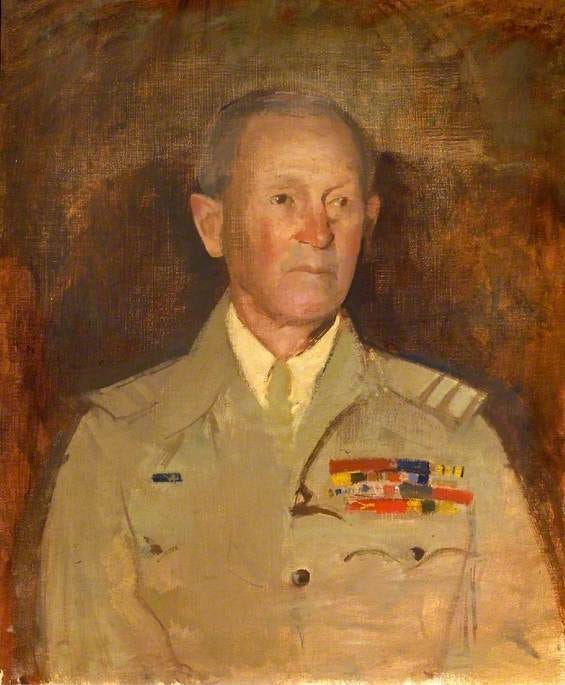
In February, 1956, there was a short little obituary in the NYT.
Admiral Sir Walter Henry Cowan, whose fighting career on sea and land spanned the conquest of the Sudan in 1898 and the North African desert campaigns in World War II, died today at his home at Kineton, Warwickshire. He was 84 years old.
That does not do the man justice. I’m not sure this short bio does either…but read it twice.
Born at Crickhowell, Brecknockshire, he joined the navy in 1884 where he was invalided twice within the first ten years of his career. He became Lord Kitchener's aide-de-camp spending the entire year of 1900 in the field. Aged 30, he was promoted to commander, and then captain, seeing action in the battle of Jutland. Following a period of unemployment he accepted the America and West Indies command and was made admiral in 1927; he became first and principal naval aide-de-camp to the King in 1930, retiring from the active list the year after.
In 1931, at age 60, he had completed what any age would say was a full and complete—and almost perfect career—was even made a baronet due to his performance off the Baltic republics after the Great War. There he finds himself with his figs and vines, Admiral SIR Walter Henry Cowan, First Baronet, K.C.B., D.S.O.*, M.V.O., R.N. (Ret.).
For a man of his generation, life expectancy at birth was of about 40, but if you made it to 60, you probably had another dozen years left.
The question for him it seems, of course, is not so much if his nation felt it has received enough service from him, but if he felt he have more service to provide his nation.
When the next war came, no easy chair for him.
During the Second World War, Cowan was given a job by his old friend Roger Keyes, then head of the Commandos. Cowan voluntarily took the lower rank of commander and went to Scotland in 1941 to train the newly formed corps in small boat handling.[1] He managed to get himself sent to the North African theatre of operations with the Commandos. Shortly after arrival he saw action at the second Battle of Mechili in April 1941.
In May 1941, in his 72nd year, Cowan took part in two abortive seaborne raids with No. 8 (Guards) Commando involving an expedition along the North Egyptian and Cyrenaica coast aboard HMS Aphis, a river gun-boat from the China Station with a top speed of 12 knots. The expeditions were repeatedly attacked from the air over several days by Axis forces before being constrained to abandon the endeavour on the second attempt through battle damage to the boat’s rudder mechanism, which limited it to going around in circles in repetition. During the incessant attacks, with scores of bombs splashing into the sea about the vessel, Cowan (believed by the commandos in whose midst he was, to be seeking a heroic death in action) was regularly to be seen on the deck blazing away at the oncoming hostile aircraft with a Tommy Gun.[5]
Cowan also saw action subsequently at the Battle of Bir Hakeim, where, having attached himself to the Indian 18th King Edward VII’s Own Cavalry, he was captured on 27 May 1942,[1] having fought an Italian tank crew single-handedly armed only with a revolver. He was repatriated in 1943 under an agreement with Italy whereby some 800 Italian seamen interned in neutral Saudi Arabia from the Red Sea Flotilla were exchanged for a similar number of British prisoners of war. An unusual feature was that there was no stipulation about the men’s future activities and they were free to return to action. Accordingly, Cowan rejoined the commandos and saw action again in Italy during 1944. He was awarded a Bar to his Distinguished Service Order for “gallantry, determination and undaunted devotion to duty as Liaison Officer with Commandos in the attack and capture of Mount Ornito, Italy and during attacks on the islands of Solta, Mljet and Brac in the Adriatic, all of which operations were carried out under very heavy fire from the enemy”.[6]
Cowan retired once more in 1945. After the war he was invited to become the honorary colonel of the 18th King Edward’s Own Cavalry, and visited India to receive the post, which he considered the greatest he had attained in his extensive military career.
There is a connection to today.
Estonia has three minesweepers. Perhaps they will deploy as part of a European effort to secure the Strait of Hormuz. If they do, one of them might show up with a very un-Estonian name: EML Admiral Cowan.
The ship’s crest is based on the Cowan family crest.
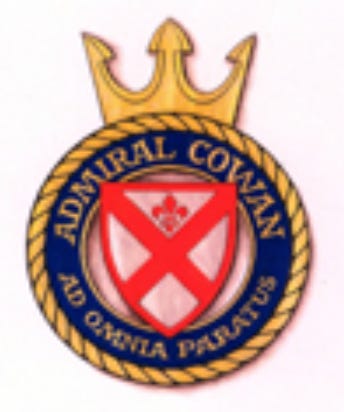
That’s a solid tribute.
Want to to know more about the British action in the Baltic in the first couple of years after WWI?
Of course you do…and of course there’s an FbF for that.
This is why I don’t like superhero movies. There are so many stories like this of TRUE heroes that have not been told. They are not bulletproof, they can’t fly and yet they do amazing things.
People like this gentleman are different in ways most of us can only admire and be grateful for, because their actions on our behalf (at times) defy logic. May he rest in peace, but only if (and it's a large "if") he chooses to...