
Tenders...MOAR Tenders
...not just for submarines

At the end of the decade, our last two submarine tenders (AS) will be decommissioned after a half-century of service.
This summer, at the last possible moment (natch), we found out what the next step would be.
The US Department of Defense (DOD) has awarded General Dynamics NASSCO of San Diego a US$72.66 million cost-plus-fixed-fee contract modification to a previously awarded contract to support the US Navy’s AS(X)-class submarine tender next generation design maturation.
The DOD said there will also be a US$27.26 million option for additional design maturation efforts, which, if exercised, could bring the cumulative value of this contract modification to US$99.92 million.
In theory, these are supposed to be one-for-one replacements.
I think that is unwise.
Two AS are barely adequate for peacetime operations. There is no flex there for wartime operations, much less for possible loss to enemy action. At a minimum, we should have a third.
And…well…the Front Porch knows where I am going here.
The CNO is reminding everyone why bringing back SIMA is so important. You know what would fit perfectly with that theme of fixing the mistakes of the accountants of the past, focus on warfighting, and all that good stuff?
Bring back the Destroyer Tender (AD).
As I reminded everyone a bit over a year ago, I have wanted destroyer tenders back in the fleet for decades. We should have four: one in the Med, one in Guam, one in Hawaii, and one on the East Coast (hey, reopen Roosevelt Roads for good and base her there as a way to support our focus on the Western Hemisphere, etc).
We have a new tender funded…let’s leverage that new hull. As our friends at Naval News reports - General Dynamics is ready to go.
General Dynamics NASSCO unveiled its internally developed concept for an AD(X) destroyer tender at the Surface Navy Association’s National Symposium in Washington last week, pitching the ship class as a near-identical ship to the AS(X) submarine tender NASSCO is building for the U.S. Navy.
…
The destroyer tender concept is based on the AS(X) submarine tender hull which NASSCO is on contract to deliver in coming years.
…
The destroyer tender, unlike AS(X), is an internal NASSCO effort. “You can take a submarine tender. It’s the same concept, same hull, and a big floating maintenance facility,” Hershman explained, justifying the reasoning behind NASSCO’s work. “If you wanted to, rather than make it two ships, you can make it a larger program.”
Having a common hull across both ship designs can reduce costs and build experience with yard workers. Short programs with few ships comes with more risk and higher cost by laws of economic ordering quantities, but with more ships in a class—or in this case sub-classes, cost and risk can be reduced while adding shipyard experience, confidence, and resilience.
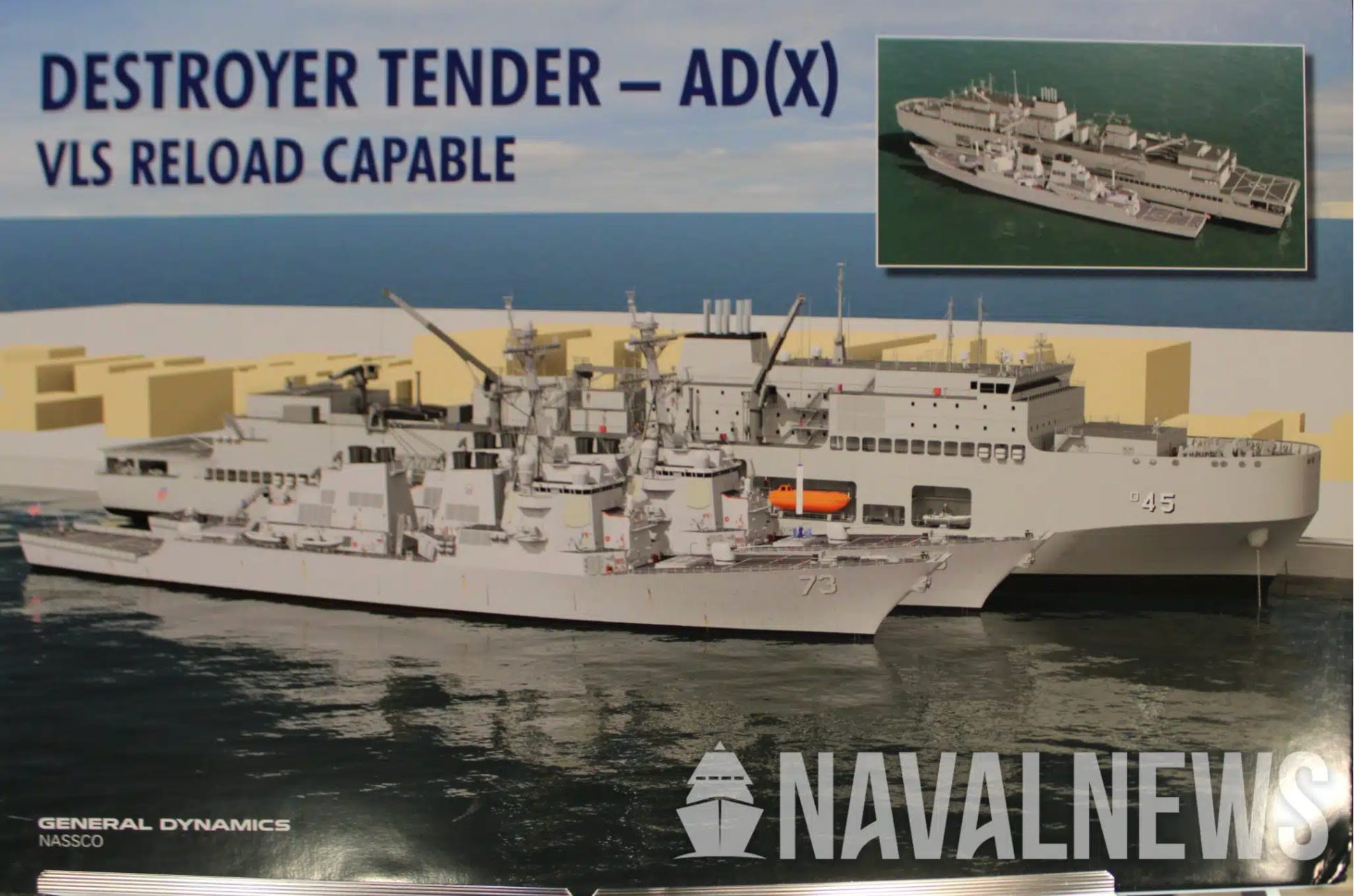
I’m sorry, it makes too much sense. Three AS and four AD. Superb Captain Commands as well.
Get building, people. The future is impatient.
I wrote a book, US Navy Pacific Fleet in 1941 (https://www.amazon.com/Navy-Pacific-Fleet-1941-battleship/dp/1472859502/ for those interested.)
One of the thing that struck me while researching the book was the emphasis the US Navy placed on its fleet train: tenders, supply ships, and floating drydocks, even before entry into WWII. These ships allowed the Navy to set up a fully functional port in an advanced base in an island lacking anything but a good harbor. (Ulithi is probably the apogee of that capability.)
The pieces were in place before Pearl Harbor, and over the next four years the fleet train allowed what became the Big Blue Fleet to move ever closer to the Japanese Home Islands and victory. A navy ignores tenders at its peril.
Two things come to mind:
First, we're going to need some kind of SHORAD/EW self defense aboard these ships. It's going to be a UAS magnet, and I expect them to be early targets. Considering how the Ukrainians are hitting Sevastopol regularly, this is a prudent decision. At the very least, fitted for but not with, or space for multiple Phalanx.
Second, the repair department does not have to be fully manned at all times short of war. Currently, the Submarine Force has Reserve Expeditionary Maintenance units that support the remaining tenders as well as other forward locations. It would be possible to have a manpower assignment based on the expected maintenance levels. One would be a voyage repair/forward reload manning level, and the other a major battle damage repair manning level.