
The Modern Deep Battle
precision and range

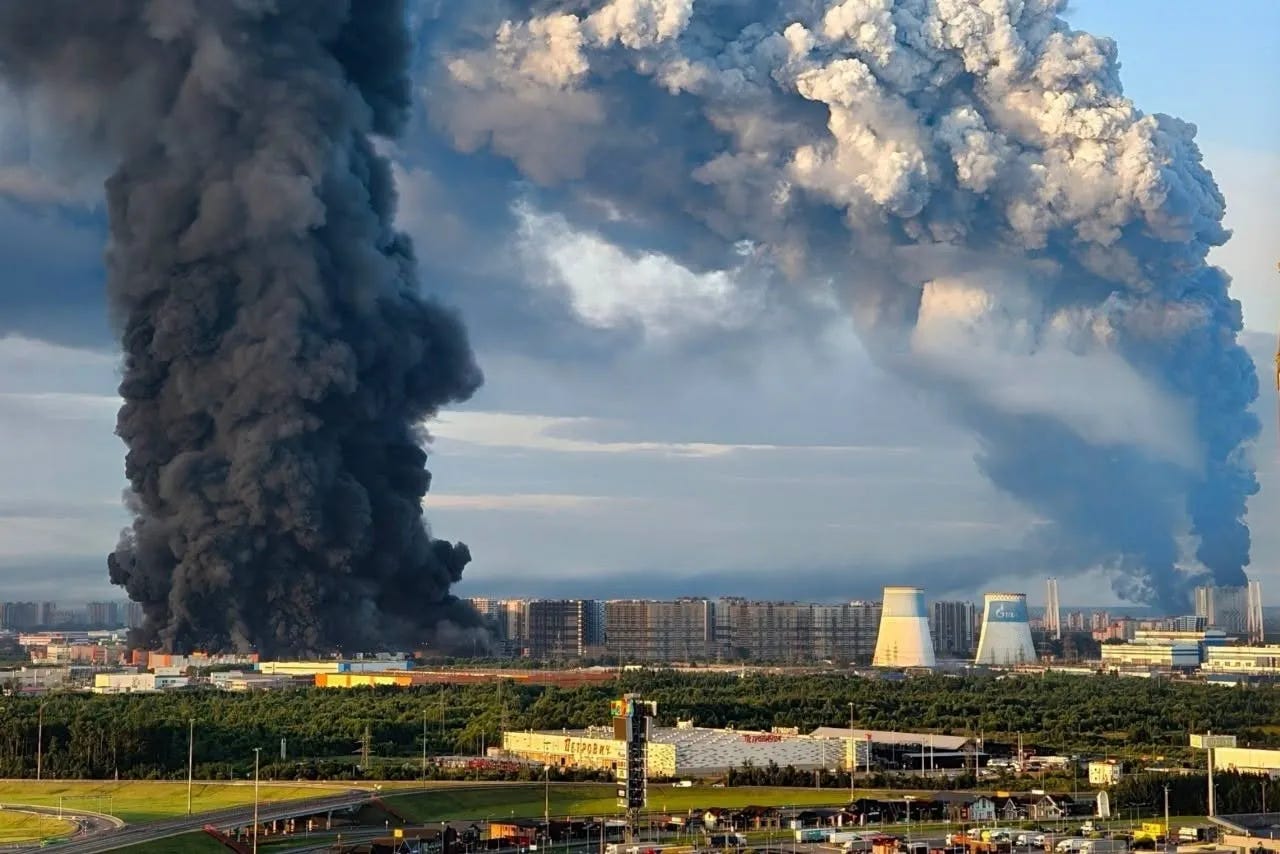
Strategic bombing campaign theory has only been with us for a century. People are still arguing everything from the utility of B-17s over Germany, B-29s over Japan, or B-52s over Vietnam, but the theory has always held promise for those who are trying to find a way to achieve from the air what would otherwise be outsourced to a long bloody slog paved with the bodies of young men in the mud.
Books are filled with the results—hundreds of thousands of civilians burned alive, starved, or crushed under rubble to take out one railroad junction moving soldiers and supplies, a ballbearing factory seen as the key to war production, mining the approaches to a port bringing in food, or simply to “bring the war home” and humiliate an opponent’s leadership in front of its people.
In some cases, the mass destruction was the goal, but usually it was just collateral damage trying to play the odds that something critical would be hit given the weapons of the time.
Accuracy. That was the issue—accuracy, or lack of it. Compensate for inaccuracy with volume.
The Germans brought a new twist to the theory with the V-1 cruise missile and V-2 Short Range Ballistic Missile (SRBM), but again, besides bringing terror, the inaccuracy of both weapons limited real practical utility.
With the atomic bomb, accuracy was not important…but if you go nuclear, even if you win, you lose.
In the decades following WWII, we’ve seen the evolution of rocket artillery—something that has been with us for centuries—towards the ballistic missile arena. A perfect example of this is the U.S. HIMARS, which can fire everything from MLRS rockets through GMLRS to the SRBMs we know as ATACMS and PrSM.
The Russo-Ukrainian War has normalized the use of not just the SRBM, but the Intermediate Range Ballistic Missiles (IRBM) by the Russians. The Ukrainians have been limited to what few ATACMS they’ve received and the use restrictions that come with them.
To compensate for their lack of ballistic missiles, the Ukrainians leveraged their ability to produce the slow, small warhead, but effective, series of drones to strike Russia at range. Recently, the large and long-range FP-2 Flamingo cruise missile has opened up even more of Russia to attack. Produced domestically, they don’t have limitations and produced in volume they can start to make significant effects.
Let’s back up a bit. What do we have now that did not exist 80 or even a decade ago?
Accuracy. Affordable, scalable accuracy.
First tier nations could fly a cruise missile through your office window, or drop a missile down your chimney, but that was a national asset—complicated to build, required a vast infrastructure to support, and outrageous amounts of money to deploy.
Miniaturization and advances in computing and navigation options have dropped those barriers. You no longer have to block out the sun with bombers and kill hundreds of thousands to disrupt industry and logistics in the deep fight—you just need range and precision.
Now what Ukraine needs are weapons at scale to do with ballistic missiles what we have watched them do this year with their drones and Flamingo cruise missiles. The key here is not that ballistic missiles will replace the broad spectrum of drones and cruise missiles they produce domestically, but that they will add to it. More tools in the weaponeering toolbox.
Diversity in weapons is hated by the Cult of Efficiency at peace, but are loved by those wanting effectiveness at war. It multiplies your effectiveness at the same time making it more difficult for your opponent to defend against your strikes.
As such, should New Year’s 2027 find this war still ongoing, the Russians will have an additional challenge to contend with.
Ukraine could launch its first strikes on Moscow using domestically developed ballistic missiles as early as this autumn, according to Denys Shtilerman, owner and chief designer of defense company Fire Point.
Speaking in an interview with journalist Dmitry Gordon, published July 27, Shtilerman said the company is in the final stage of testing a new missile system. Once test launches are completed, the missiles could begin being used against targets inside Russia.
…
The company plans to manufacture between 10 and 20 missiles for test launches, with production potentially increasing to dozens of units once the weapon receives official codification and procurement approval.
Fire Point is one of Ukraine’s largest defense contractors, producing the FP-1 long-range strike drones and FP-5 Flamingo cruise missiles. The company announced the development of its FP-7 and FP-9 ballistic missile projects in September 2025.
The first test launch of the FP-7 was shown in February. The missile is reportedly designed to strike targets at distances of up to 250–300 kilometers, while the larger FP-9 is expected to have a range of up to 850 kilometers.
The challenge will be to launch as close to Russia as possible to reach the most targets. My assumption would be that the Ukrainians will use the modified flatbed trailer Transporter Erector Launcher (TEL) system they use with the FP-5 Flamingo. Ungainly, not ideal, but affordable and already proven.
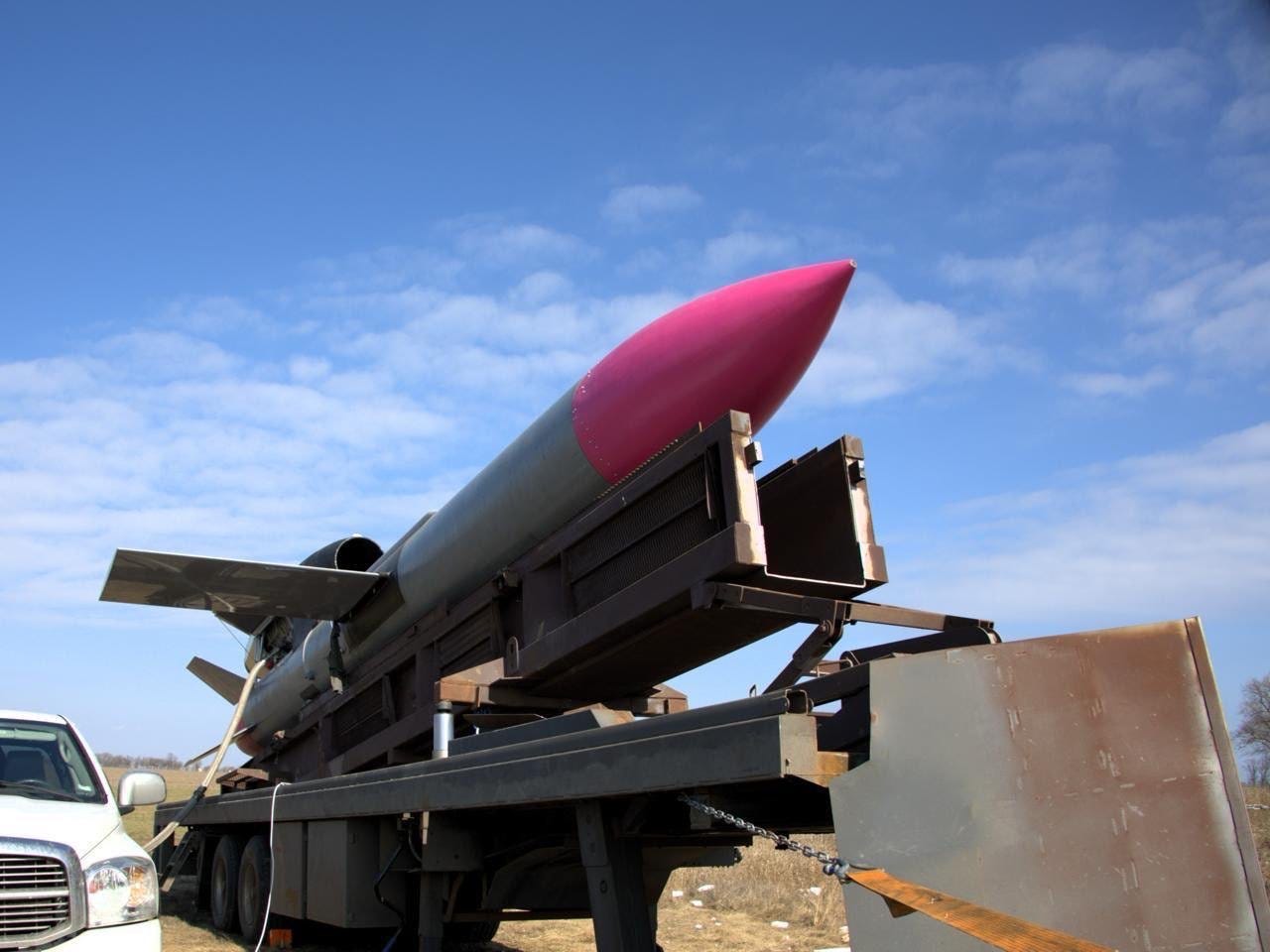
Downside is that they are easy to find, hard to hide, and limited to the roads you can take them on. For much of the year, I would also assume they would be limited to paved roads.
I’ll let the pros figure that out, but as always, let’s go to the map room and put some geography to those numbers.
If you wanted to get as close as possible to the Russian heartland that runs from Moscow to St. Petersburg, you’d want to get your launch site as close as possible. For planning purposes, let’s pick the forested openings around Benzyky.
Where would that get you?
To start with, most people are familiar with the ATACMS and PrSM mentioned at the top of the post. In open source, generally you have a range of 300 km (Carolina blue) and 500 km (Duke blue). The FP-7 will get you 250 km (NC State red) and maybe more. The FP-9 will get you out to 850 km (Clemson orange).
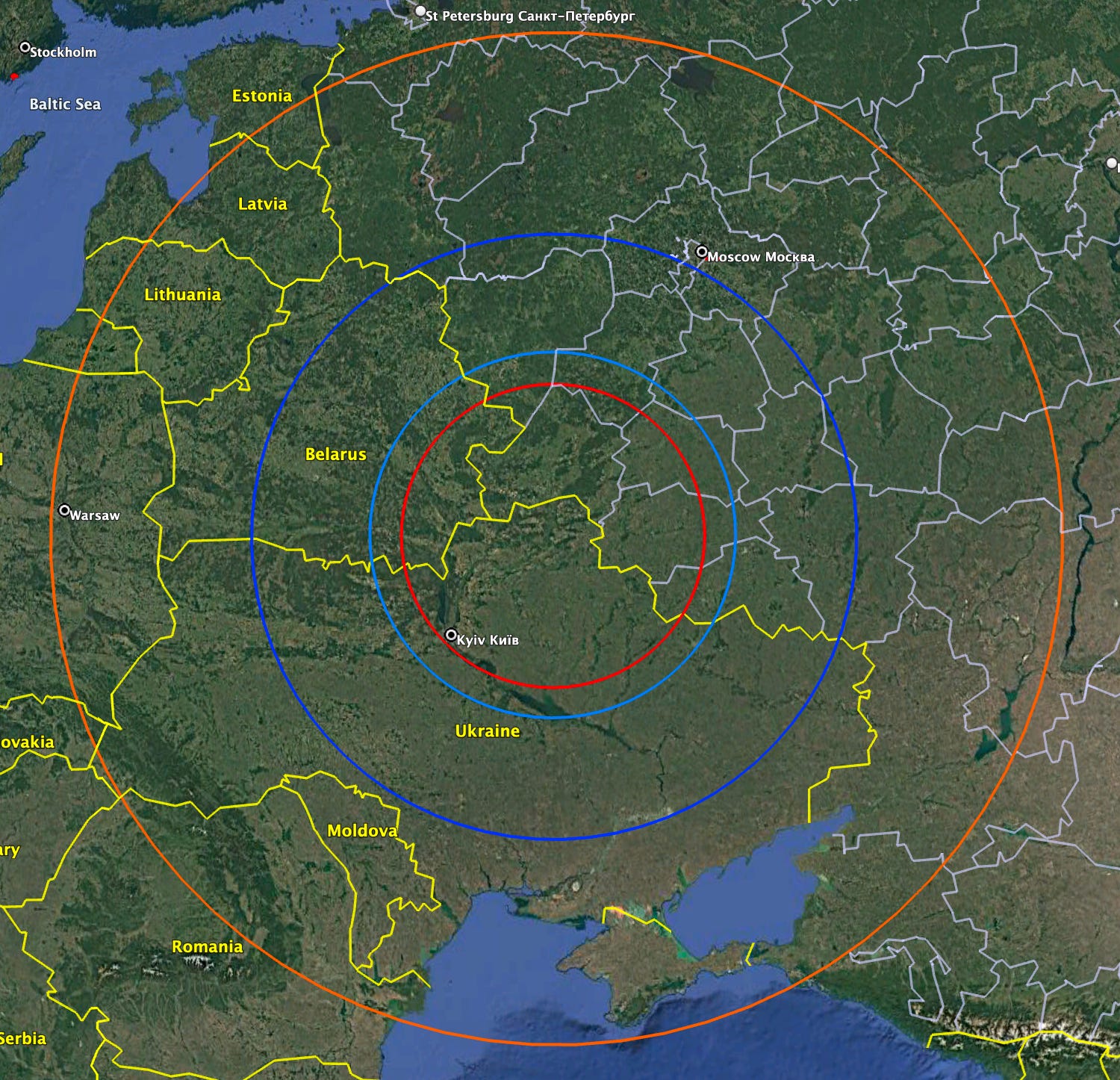
If instead you wanted to use these weapons elsewhere, just move around.
Always have a good toolbox…and one note to put in your Future-Risk folder:
Assuming Ukraine can finish this war to her rough advantage with independence, she will have a few challenges.
Expunge the culture of corruption.
Rebuild her economy.
Make babies.
In this scenario, she will have some of the most combat proven and affordable weapons systems out there in production. To meet #2, she has to leverage every competitive advantage she has to generate income and support well paying jobs. She will be selling her weapons to whoever has the hard cash to buy them.
Just put that tidbit in your folder.
"Expunge the culture of corruption."
With all respect, but you could also set the goal of "making Pi number exactly 3". Nearly as realistic)
Back in the late 1980s, I worked several programs under the aegis of PMA-201, the Conventional Air-Launched Ordnance program office (colloquially referred to as "bombs and bullets").
One of them was designated with the bland nomenclature IAM ("Inertially-Aided Munition"). This was an inertial platform--later augmented with GPS--and a set of movable fins, to be installed on a Mk-82 500-lb "dumb bomb." There were two versions: one for a standard bomb and one for the Snakeye (IYKYK).
During OPEVAL, these demonstrated a reduction in CEP (Circular Error Probable) from 30 meters to 3 meters. This was absolutely astonishing at the time. The IAM cost about $10-15k, which seemed like a low number for someone like me, who was used to paying six figures for a single guided missile, but it was still an expensive upgrade considering that it was around 10X the cost of a Mk-82.
I imagine we've gotten better.