


The War Gods of the Copybook Headings Return
math is harder if you ignore it

Industrial capacity feeds logistics. Logistics win wars. Logistics is math. Math is unforgiving to the complacent.
If you are looking for early lessons of the Russo-Ukrainian War, there are two that need to be underlined today.
Lesson 1: Don’t Fall for the Short War Fallacy:
This is a known fallacy throughout human history, but every generation must be reminded of it, sometimes more than once. At peace, people will find reasons – either phycological or financial – to promote the promise of a short war either through their superior ideas or exquisite weapons. Good people desiring good things are easily seduced by this peace-time siren’s song.
The Russians thought that the Ukrainians would fall in 3-5 days and planned for it. The United States and Western Europe thought that so much they tried to convince the Ukrainian government to retreat to Lviv or even Poland before the first Kalibr cruise missile received intent-to-launch. Before the war, the Ukrainians did not believe the Russians would actually do this – but the moment the first Russian boot stepped off a Mi-8 at Hostomel, they knew they were in for an existential fight … and here we are at the start of month-5 of the war.
Action 1: have hard follow-on questions for anyone who is promising a short war or is selling a “Win in 72-hr Posture.” It briefs well, but it almost never works out. Everything has to be executed perfectly and your opponent have no agency. What is their “Plan-B” or will it be like Iraq 2003’s “Phase 4” or the Russian retreat from Kiev when reality hits?
Lesson 2: The Hard Math of Shallow Magazines:
You are short of everything because you didn’t believe the warnings of Lesson-1. We have all read volumes the last few months of all the friends of Ukraine scouring the deep recesses of forgotten magazines for former Soviet compatible ammunition that could be sent to Ukraine. Well, that which was not destroyed pre-war by the Russian clandestine services. Because the answer was too painful for peacetime leaders to ponder, no one wanted to do the math of what a real war would mean. That is the subject of today’s post.
Action 2: Tell the Cult of Efficiency to Get Bent; You Have a War to Prepare For.
Alex Vershinin over at the Royal United Services Institute has a must read article I’m going to pull some quotes on supporting Lesson-2 titled, The Return of Industrial Warfare.
The rate of ammunition and equipment consumption in Ukraine can only be sustained by a large-scale industrial base.
This reality should be a concrete warning to Western countries, who have scaled down military industrial capacity and sacrificed scale and effectiveness for efficiency. This strategy relies on flawed assumptions about the future of war, and has been influenced by both the bureaucratic culture in Western governments and the legacy of low-intensity conflicts.
...
The winner in a prolonged war between two near-peer powers is still based on which side has the strongest industrial base.
From small arms to nuclear submarine repair, our industrial base is exquisitely designed and Tiffany-tough. Any unexpected shock can almost make the whole system grind to a stop. Though the roots go deeper, this is a direct byproduct of the 1990s “Send all senior defense leaders to a 2-week MBA school” mentality and its second order effects. The Cult of Efficiency’s green eye-shade priorities took the place of the bookshelf full of history’s example.
It didn’t take the Russo-Ukrainian War to expose this. We saw this in 2011’s operations against Libya and the war in Iraq.
...there is an assumption about overall ammunition consumption rates. The US government has always lowballed this number. From the Vietnam era to today, small arms plants have shrunk from five to just one. This was glaring at the height of the Iraq war, when US started to run low on small arms ammunition, causing the US government to buy British and Israeli ammunition during the initial stage of the war. At one point, the US had to dip into Vietnam and even Second World War-era ammo stockpiles of .50 calibre ammunition to feed the war effort. This was largely the result of incorrect assumptions about how effective US troops would be. Indeed, the Government Accountability Office estimated that it took 250,000 rounds to kill one insurgent. Luckily for the US, its gun culture ensured that small arms ammunition industry has a civilian component in the US. This is not the case with other types of ammunition, as shown earlier with Javelin and Stinger missiles. Without access to government methodology, it is impossible to understand why US government estimates were off, but there is a risk that the same errors were made with other types of munitions.
As I alluded to above, there are some important influencers in the natsec arena who are in love with the “72-hr War.” Their premise is that if we design our force around convincing the Chinese – and ourselves – that in the first 72-hrs we have the capacity to destroy any ability of the enemy to proceed towards their objectives then they won’t start the war. If they do, well, we have what our wargames tell us we need to win in 72-hrs.
I’m sorry, but your modeling and wargames are just that – models and games. You tell any competent designer what outcome you want, and they/we can tweak the assumptions and variables such that we can give you that result. I am very sure all the Russian models and wargames showed them conducting a victory parade in Kiev before March … but how did that work out for them?
If you don’t win quick – there are no mulligans in war. Let’s quote me again; “Industrial capacity feeds logistics. Logistics win wars. Logistics is math. Math is unforgiving to the complacent."
...390 daily missions fired by tube artillery...With four guns per battery and four rounds per gun, the tube artillery fires about 6,240 rounds per day. We can estimate an additional 15% wastage for rounds that were set on the ground but abandoned when the battery moved in a hurry, rounds destroyed by Ukrainian strikes on ammunition dumps, or rounds fired but not reported to higher command levels. This number comes up to 7,176 artillery rounds a day. It should be noted that the Russian Ministry of Defense only reports fire missions by forces of the Russian Federation. These do not include formations from the Donetsk and Luhansk separatist republics, which are treated as different countries. The numbers are not perfect, but even if they are off by 50%, it still does not change the overall logistics challenge.
Presently, the US is decreasing its artillery ammunition stockpiles. In 2020, artillery ammunition purchases decreased by 36% to $425 million. In 2022, the plan is to reduce expenditure on 155mm artillery rounds to $174 million. This is equivalent to 75,357 M795 basic ‘dumb’ rounds for regular artillery, 1,400 XM1113 rounds for the M777, and 1,046 XM1113 rounds for Extended Round Artillery Cannons. Finally, there are $75 million dedicated for Excalibur precision-guided munitions that costs $176K per round, thus totaling 426 rounds. In short, US annual artillery production would at best only last for 10 days to two weeks of combat in Ukraine. If the initial estimate of Russian shells fired is over by 50%, it would only extend the artillery supplied for three weeks.
...
The expenditure of cruise missiles and theatre ballistic missiles is just as massive. The Russians have fired between 1,100 and 2,100 missiles. The US currently purchases 110 PRISM, 500 JASSM and 60 Tomahawk cruise missiles annually, meaning that in three months of combat, Russia has burned through four times the US annual missile production. The Russian rate of production can only be estimated. Russia started missile production in 2015 in limited initial runs, and even in 2016 the production runs were estimated at 47 missiles. This means that it had only five to six years of full-scale production.
...(a)crucial assumption is that industry can be turned on and off at will. This mode of thinking was imported from the business sector and has spread through US government culture. In the civilian sector, customers can increase or decrease their orders. The producer may be hurt by a drop in orders but rarely is that drop catastrophic because usually there are multiple consumers and losses can be spread among consumers. Unfortunately, this does not work for military purchases. There is only one customer in the US for artillery shells – the military. Once the orders drop off, the manufacturer must close production lines to cut costs to stay in business. Small businesses may close entirely.
Now is the time for Congress to force The Pentagon to stop with foolish ideas. Demand to see the full inventory for everything from 5.56mm to 21-inch torpedoes and run the long war. Not 72-hrs, but 72-weeks. Heck, take an extra day and make it 72-months.
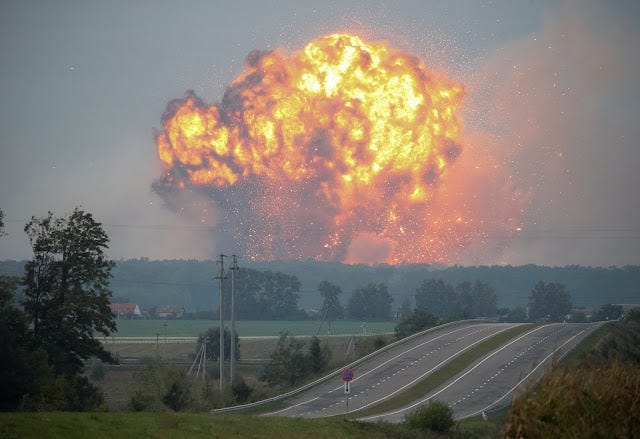
Look at our single points of failure. From magazines and airfields west of Wake to production facilities in CONUS – expect at war that through direct action or sabotage, we will lose some of these facilities/capabilities. The Chinese have seen this in the build-up and execution of the war by the Russians against Ukraine. They will go after these non-resilient targets that even without prompting can go up in a – pun intended – flash. There is even a term of art for it; Unplanned Explosions at Munitions Sites (UEMS).
We need to start acting on this now. There are more lessons to come, but we don’t have to wait for them all to come in – we don’t have time to.
As the PEO in charge of all Navy/Marine Corps air to ground weapons and the Tomahawk weapons system during and after 9/11 I can attest to the difficulty for both government and industry to gear up to wartime production from peacetime status. While congress was fairly quick i providing funding for increased production of much needed weapons there are still the requirements to put contracts in place to officially start the ball rolling. But, alas, having timely funding in hand doesn't mitigate long lead on critical components. Many of the more critical electronic components had a six month lead time. INS's for JDAM munitions is a case in point. In response to discussions with our weapons suppliers, many of them committed company funds to purchase long lead items even before they had a government contract.
One partial solution to the "peacetime inventory" issue would be to have a stockpile of critical long lead items. We need to caution ourselves when we have a single source for our most highly used munitions. As pointed out in your article, during hostilities a lot of ordnance goes down range in a short period of time. One peacetime contractor may not be able to ramp up to wartime production.
Logistics and math are hard, and this is a hard subject to get explain. This is one of the most important pieces I've seen from you Sal. I hope some of the Pentagon guys see this and heed the warning.
Oh, exquisite. I thought exquisite intel would solve these issues. Nice.