
We Have a Shipbuilding Plan
...make your arguments, because this isn't a make the donuts plan...

BZ to the folks who decided not to release it the Friday before Mother’s Day Weekend. Yesterday, Acting SECNAV Cao released the U.S. Navy’s Shipbuilding Plan.
Let’s dive in, but first, the usual caveats we’ve used over the last couple of decades when reviewing such items.
Ignore the out years. They are notoriously inaccurate in both numbers and type.
Focus on what you see four years from the year it is issued. The next four years, meh. Beyond that…don’t bet your lunch money on it.
There’s a LOT here to dive into. You need to read it all. I’m just going to hit the bright, shiny objects.
I would argue that one of the more valuable things, if you are trying to get your mind around where the sustained effort will be, is to look at the opening statements by the SECNAV, CNO, and CMC.
Here is what I pulled as the core from the SECNAV:
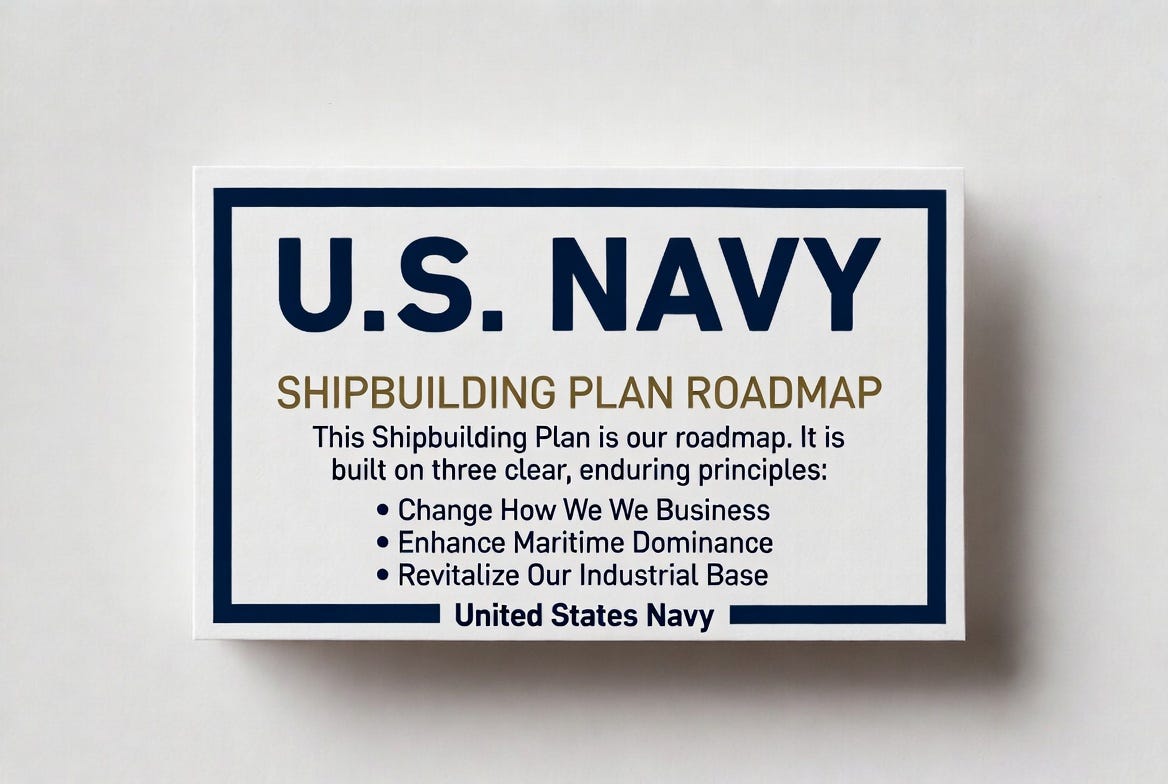
This Shipbuilding Plan is our roadmap. It is built on three clear, enduring principles:
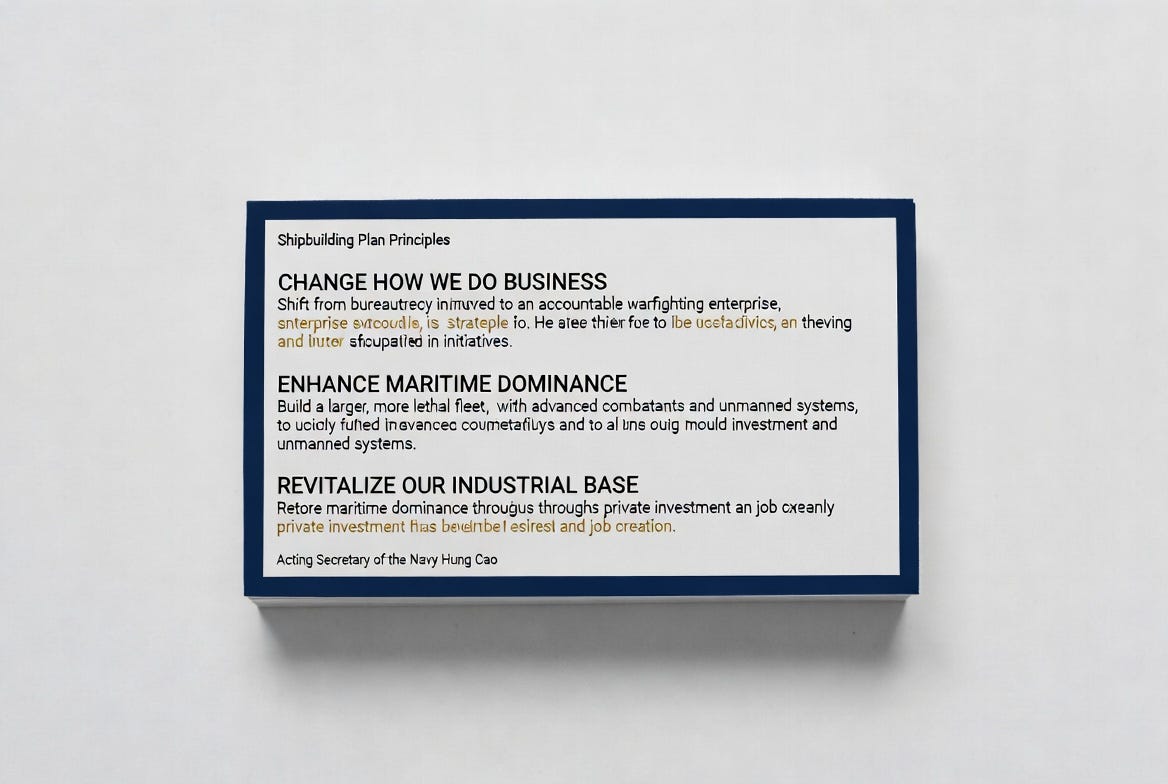
Change How We Do Business: We are shifting from a slow, compliance-based bureaucracy to an accountable, warfighting enterprise. We will demand performance, reward speed, and empower our partners to deliver. We will no longer tolerate the backlogs that put our mission and America’s sons and daughters at risk.
Enhance Maritime Dominance: We will build a larger, more lethal, and more balanced fleet. The Golden Fleet will deliver a high-low mix of advanced combatants, cost-effective frigates, and unmanned systems, giving our commanders the combat mass and flexibility to win any fight, any time.
Revitalize Our Industrial Base: In accordance with the President’s Executive Order, we will “Restore America’s Maritime Dominance” and ignite a renaissance in American shipbuilding. Through a stable, long-term demand signal, we will unleash private investment, expand our manufacturing capacity across the nation, and create thousands of high-skill American jobs. A strong industrial base is not just an economic goal; it is a national security imperative.
Woe be to anyone who cannot have a connection to any of those three items and they’re asking for money or political top-cover. Print it out. Keep a copy in your pocket, and a companion piece on your desk.
Heck, put it on a business card and hand it out. Here, I’ll even do the work for ‘ya. AI screwed up some of the verbiage on the back, but you get the idea.
Next to the CNO. Members of the Front Porch, take a bow. You’ll recognize this:
We are operating in an era defined by persistent competition, rapid technological change, and adversaries who are expanding their naval forces at scale. Because the future fight cannot be predicted with certainty, our approach is guided by the Hedge Strategy that builds a balanced, adaptable force designed to maintain decision advantage, preserve escalation dominance, and prevail across the full spectrum of operations, from daily campaigning to high-end combat.
Spot on. From the Hedge Strategy to future-proofing through the rest. Salamanderesque. I would not change a word.
In the middle of the document, the Hedge Strategy is better defined.
HEDGE STRATEGY
The Hedge Strategy is the CNO’s approach to force design and investment that reduces operational risk across the spectrum of competition and conflict by combining a ready main battle force with tailored, mission-specific capabilities. It pairs high-end, multi-mission platforms that can deliver massed, sustained f ires on demand with modular, rapidly deployable systems. These are often lower-cost, attritable and address specific threats or operational gaps, augmenting the main battle force while providing operational flexibility, production volume and are rapidly deployable. Together with joint, allied, partner, and industry contributions, enabled by concepts of operation and command and control that support distributed decision-making, this combination of forces and capabilities provides a model to build and field a Navy that can deter and win a high-end, peer-level fight, while simultaneously meeting the relentless, day-to-day demands of global presence and crisis response. To better measure and manage this force and as required by law, the Hedge Strategy will inform an updated Battle Force Ship Assessment and Requirement, which will be released in the coming months to provide an accurate, modernized assessment of the vessel requirements for the Fleet of the Future.
How about the Commandant:
Our strategy is centered on maintaining a decisive expeditionary advantage, ensuring our forces can gain and maintain access in the world’s most contested littorals. This approach leverages the unique capabilities of the Amphibious Ready Group and Marine Expeditionary Unit (ARG/ MEU), the premier force offering of the Marine Corps. Forward deployed, the MEU provides our national leadership and Combatant Commanders with combat credible forces that are persistently on-scene and contribute to deterrence, campaigning, crisis response, and combat operations. A continuous 3.0 ARG/MEU presence is required to provide Geographic Combatant Commanders, and our Nation, with the forces they need to meet the challenges presented across the globe.
This Shipbuilding Plan significantly improves our posture and marks a historic and unprecedented commitment to our amphibious forces, representing the most significant fleet recapitalization effort in decades. Through committed procurement of modern platforms, including LHA, LPD, and Medium Landing Ships, we are making a generational investment in our capacity for naval campaigning and crisis response. This undertaking will guarantee that your Marines and Sailors remain forward postured, holding potential adversaries at risk and standing ready to answer the nation’s call with overwhelming force.
Meat and potatoes, and not a sniff of some of the narrowly defined concepts that limit what should be the nation’s primary expeditionary force to project power ashore.
Now, into the meat of the document. The high/low mix is back.
The Fleet of the Future is a high-low mix of platforms. It must also be a buildable and sustainable combination of platforms that are maintained to end of their service life. High-end platforms remain essential, but they must be complemented by systems that can be produced at volume and adapted in real time. That includes a range of unmanned systems operating everywhere from the seabed to space, fully integrated with current force structure. The highlow mix is how we increase new market entrants and competition within the industrial base.
Rear Admiral Wayne E. Meyer’s, “Build a Little, Test a Little, Learn a Lot,” is back on the menu.
Acquisition strategies will be structured around iterative development cycles to deliver capability to the fleet faster and align with evolving mission needs. This approach emphasizes early and continuous engagement with operators and stakeholders to inform requirements, business case decisions, and design maturity. From program inception, we will account for total lifecycle cost and integrate sustainment, maintenance, and modernization into design decisions to avoid the costly readiness challenges that have historically emerged after delivery.
There is a refreshing amount of detail that follows here on acquisition reform. It is a bit esoteric, and really, the proof of the pudding is in the eating. By its fruits we will know it, etc., but if you love bureaucracy tinkering, pages 9-13 will be your happy place.
The Fleet Design is broken into four parts:
Future vessel inventory is reflected in Table 1-1.
High-End Combatants: Provide survivability, command and control, and massed fires (e.g., CVN, SSBN, SSN, BBGN, DDG, LHA, LPD)
Low-End Combatants: Provide presence, scalability, and distributed operations (e.g., Frigate, LCS, LSM)
Unmanned Systems: Provide tailorable mass, sensing, deception, and attritable combat power (e.g., MUSV, SUSV, UUV, and other types)
Logistics and Support Ships: Enable sustained operations in contested environments (e.g., T-AO, T-AOL, AS(X), Sealift)
Definitions have shifted as well.
For the first time, the Navy is displaying a combination of battle force ships, auxiliary ships and unmanned vessels in the 30-year Shipbuilding Plan. This inclusion is driven by the level of maturity in unmanned vessels, which are now projected to be able to perform CNO-approved operational requirements. The unmanned vessels counted are limited to MUSV, based on (1) the projected ability to meet specific CNO-approved operational requirements that are similar or closely related to those of manned naval vessels, (2) having an approved acquisition strategy, and (3) having procurement funding budgeted. Smaller unmanned systems, while important to current and future fleet design and accounted for elsewhere in budget and program materials, do not meet all three criteria for inclusion in this Plan. Similarly, auxiliary vessels are essential to sustaining and resupplying the Fleet. Recapitalizing a range of auxiliary classes is a priority of this Administration. Accordingly, auxiliary vessels are also being counted alongside battle force ships and covered unmanned vessels. Taken together, these three categories comprise the Total Naval Vessel Force, which will provide a more comprehensive measure of naval combat.
So, what do the numbers look like? Remember my “four years” comment above?

If you want a 300+ ship navy, you’re going to need to wait until next decade.
What are we buying?
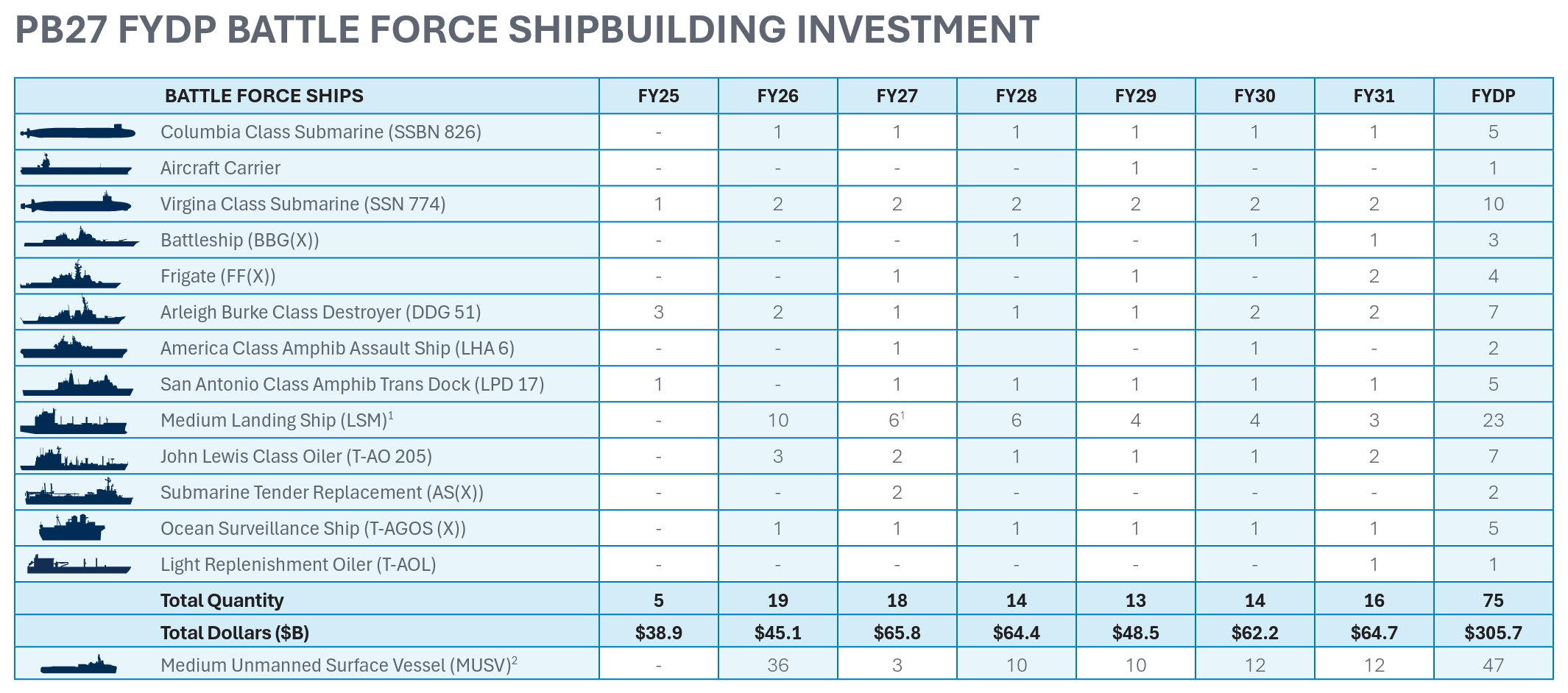
I’m not happy with that CVN buy…but those three battleships are going to soak up a lot of money, manpower, and institutional capital to get to the point they’re displacing water, and that is probably part of it, but I’m still not sold this would cause this much of a delay.
We are currently reviewing the CVN 82 design baseline to further increase lethality, enhance survivability, and improve producibility, while also simplifying the design and potentially leading to decreased cost. Once this review is complete, we will conduct a detailed analysis to determine the optimal procurement and construction approach for CVN 82. We anticipate continuing to program advance procurement funds for industry-critical and long lead material.
I’d like some destroyer tenders…but, we are getting…
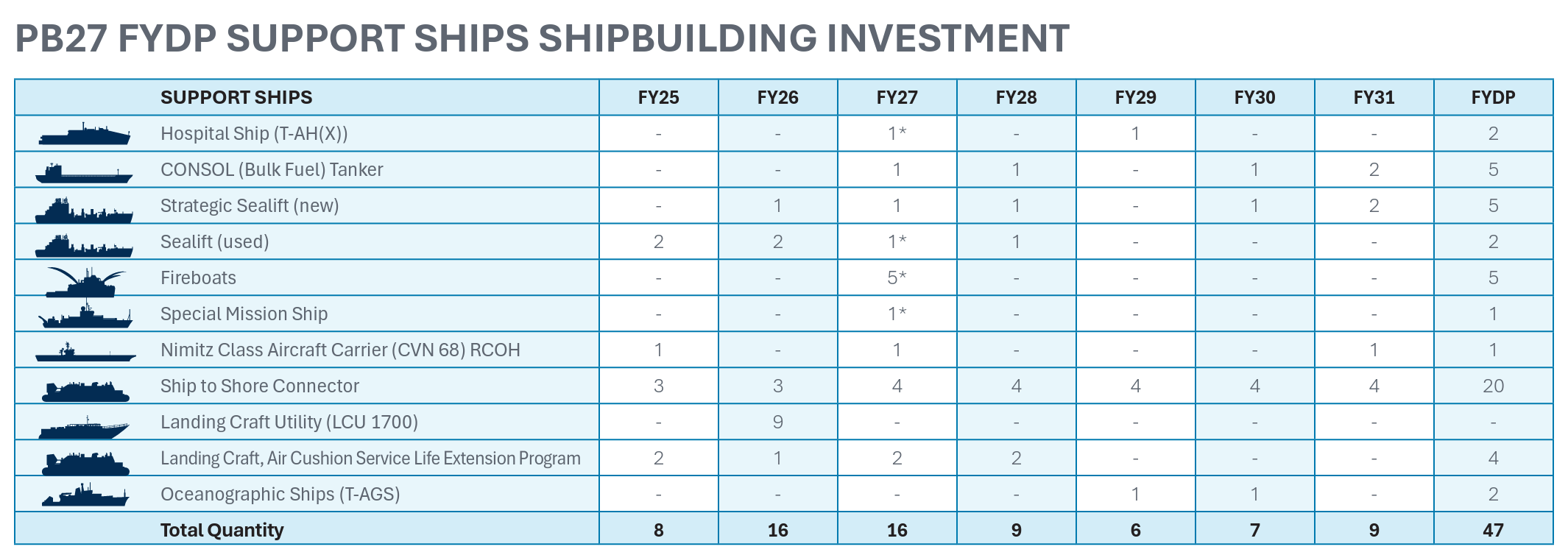
…fireboats…and whatever those “Ship to Shore Connectors” are.
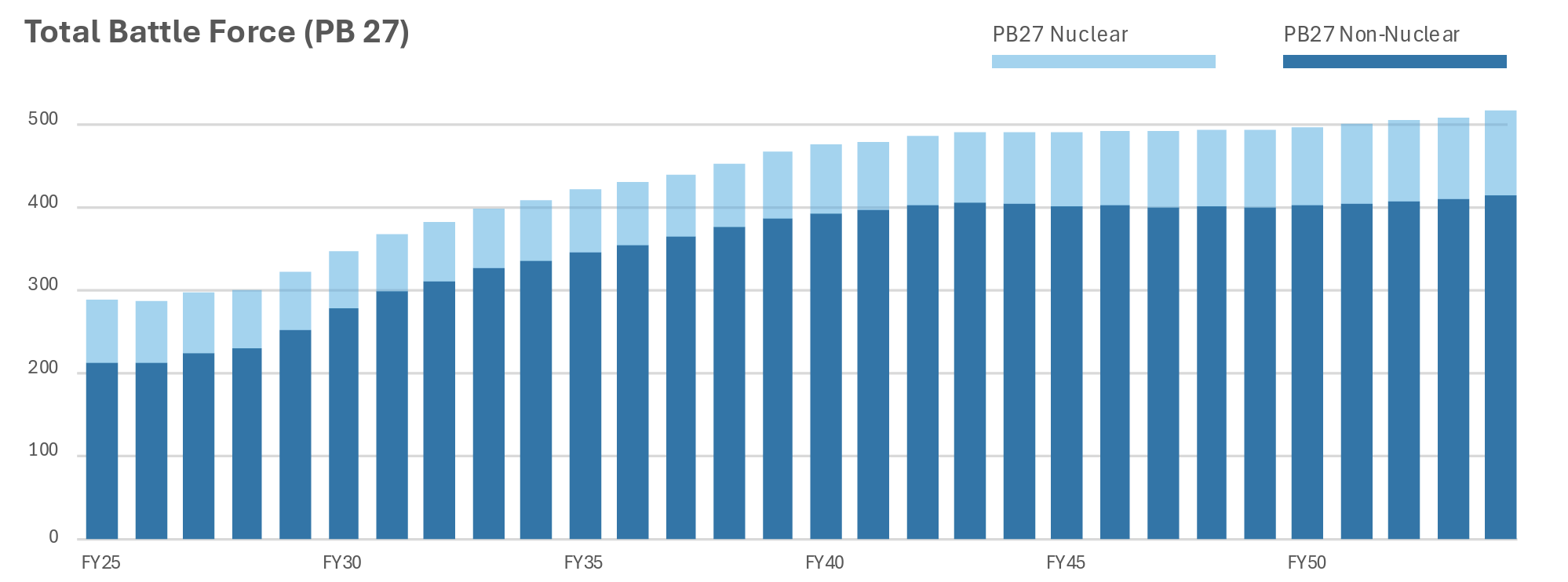
Remember: four to 2030, four more to 2034…over 400?
Only. If. You. Can. Sustain. Funding.
As for 2035 and on…I’m not even going to argue the points for reasons discussed earlier.
Now, get ready for a head fake. Look again at the battleship line in the battle force graphic. “BBG(X)”.
Well, not really.
BATTLESHIP (BBGN)
The Battleship addresses a fundamental requirement in modern naval warfare: the need to generate sufficient combat mass to culminate battle. In an era where distributed forces provide reach and sensing, the Battleship provides decisive, high-volume fires and survivable command and control, enabling the Fleet to transition from shaping to decisive action. This validated requirement for high end surface capability directly supports the Navy Warfighting Concept (NWC) and Expanded Maritime Maneuver (EMM).
The Arleigh Burke-class guided-missile destroyer (DDG 51) is the most capable surface combatant anywhere at sea, but we have reached the limits of its capacity. Even the planned DDG(X) program made undesirable capability and weapon system compromises. Our Fleet deserves and our national security requires the most comprehensive capability a surface combatant can provide, not just what we can make do with tradeoffs. The nuclear-powered Battleship is designed to provide the Fleet with a significant increase in combat power by longer endurance, higher speed, and accommodating advanced weapon systems required for modern warfare.
That’s right, there’s an “N” in there. Was the decision made after the graphics were completed that the new battleship would be nuclear powered, because in the graphics it is referred to as “BBG(X)”, a conventional ship, and not “BBGN(X)”, a nuclear powered ship.
Yes, these things matter. Once a Flag Sec., always a Flag Sec. I may not be able to properly edit my own stuff, but…
Let’s go back to my post back in October of last year before the battleship initial roll out. I assumed at the time it had to be nuclear powered for these reasons:
…if they are nuclear powered, which they probably need to be as you will need the “white space” in the design for the weapons and radars that are coming, all of which are power hungry.
… look at the USS Salamander at the top of the post. It has 31 Advanced Payload Modules (APM). That gives you 31x3=93 CPS missiles. The Zumwalts carry 80 missiles besides CPS, so a battleship should have at least 50% more than that. Let’s call it 120 missiles in MK-57 or MK-41 VLS cells.
So, a nuclear powered, guided missile battleship. USS Salamander (BBGN-1)...
Pages 20-22 outlines what the proposed battleship will bring to the table. We will see what the final design looks like, but I stand by a few things:
It must bring Conventional Prompt Strike forward in significant numbers.
The proposal to deploy “tactical nuclear weapons” on the platform is a waste of time and money. I know the arguments for them and they are brittle, weak, and exquisite. Not worth the distraction.
I think well-meaning people can argue pro or con the battleship, but I find it tiresome that a plurality of the anti-BBGN crowd seem to be making their argument simply because it has a Trumpish tint to it.
As I outlined earlier, a large nuclear powered warship has been a well-identified requirement since the 1970s that kept getting yanked for cost reasons.
The arguments regarding DDG(X) in the document sound about right:
Even the planned DDG(X) program made undesirable capability and weapon system compromises. Our Fleet deserves and our national security requires the most comprehensive capability a surface combatant can provide, not just what we can make do with tradeoffs.
As we discussed back earlier this year, DDG(X) may be what the Navy winds up with in the mid-to-late 2030s because…wait a minute…that’s a bit of unnecessary shade being thrown at DDG(X), isn’t it?
<does quick word check>
…ummm, That is the only mention of DDG(X) in the document.
<dramatic music>
DDG(X) isn’t dead, is it? Looking at the procurement profile (see below) I see DDG building through the 2050s. I assume that would mean at some time it would be DDG(X) being built, right. I know I make the “build Arleigh Burkes until the crack of doom” snide remarks all the time…but…I’m just kidding.

If anyone has more on this, please let us know in comments…but let’s move on.
Unmanned systems get a bit too much hype amongst liberal arts majors who read more military fiction than military history, and you can read a little bit of that here, but you can also find statements that represent sound thinking.
In the next five years, the Navy will field dozens of medium unmanned surface vessels and has previously delivered hundreds of small unmanned surface vessels through FY26. These vessels will deploy with carrier strike groups and expeditionary strike groups as well as operate independently. These platforms will facilitate rapid development of operational concepts for future tailored force packages.
…
Autonomous UUV systems offer unprecedented capabilities for intelligence gathering, surveillance, and reconnaissance (ISR) in contested maritime environments and free up our manned submarines or surface vessels when it is advantageous to do so. UUVs conduct persistent silent patrols, map seabed, conduct ISR, and are an integral source of our undersea dominance.
There is also some very good, and important, discussion about the shipbuilding industrial base, maintenance, workforce, and foreign opportunities towards the end. Again, an important, though esoteric subject that is a bit too much to cover on today’s post.
There is one thing that did get my attention in the appendix.
I have lamented before about the loss of the rather unique strike capabilities our soon-to-be-decommissioned SSGN bring to the table.
Well…it looks like SSGN are back on the menu as well.
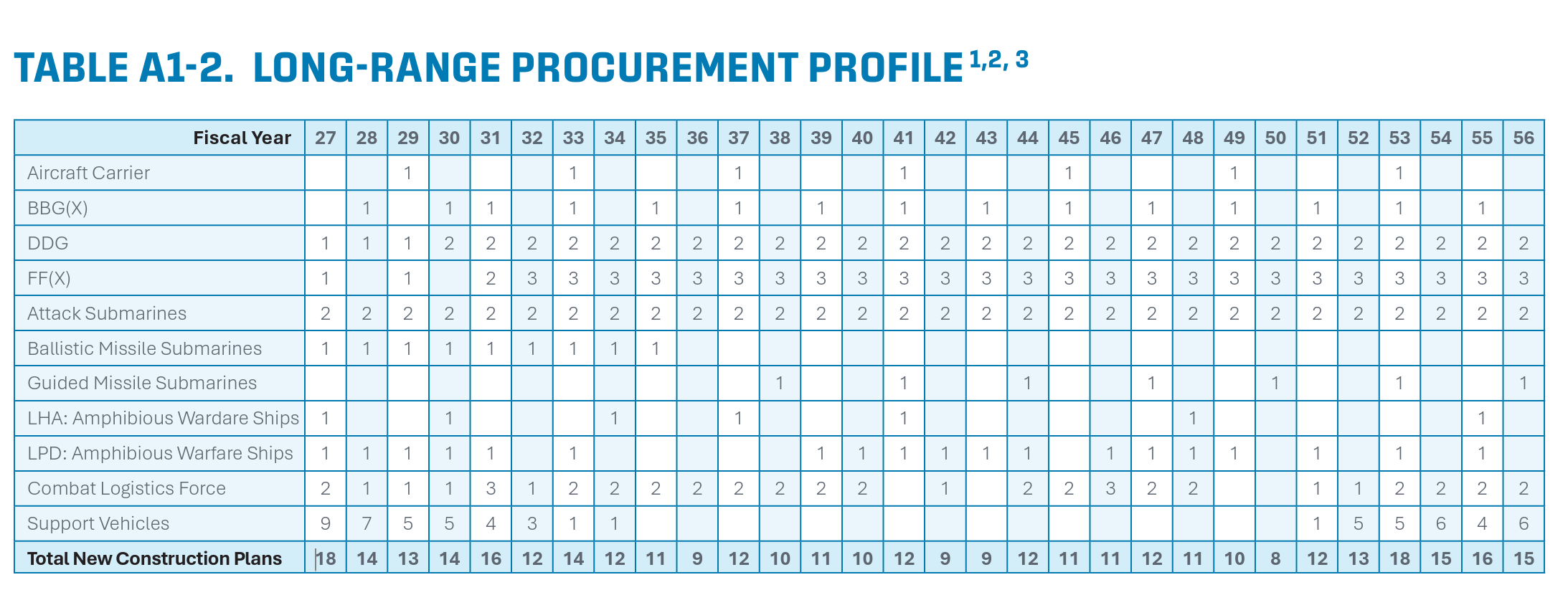
I don’t see any additional mention of them in the document. Which flight of what class will these be?
Whatever it is, it has my support.
We are flush with money and are making investments, this is good. Is it exactly what I would like? No. Will I take it and say, “Thank you.”?
100%.
Cut steel.
Gray steel and no diversity.
I love it.
I am pleased to see that the Gator Navy and MSC were not neglected as amphibs and UNREP are necessary if you want to be global power.
Bases need to be overhauled, too so as to accommodate both ships and sailors.
The plan means the Navy has a future which will do wonders for both recruiting and retention. Who wouldn’t want to be part of a BB PCU?
The next step is to integrate the Navy with the rest of the maritime domain - cables, fishing, offshore wells, research, commercial shipping, etc.
No destroyer tenders. Also, if one is going to field that many unmanned vessels, won't we need drone tenders?