
CBO Ponders BBGN
...there will be math, history, and psychology...

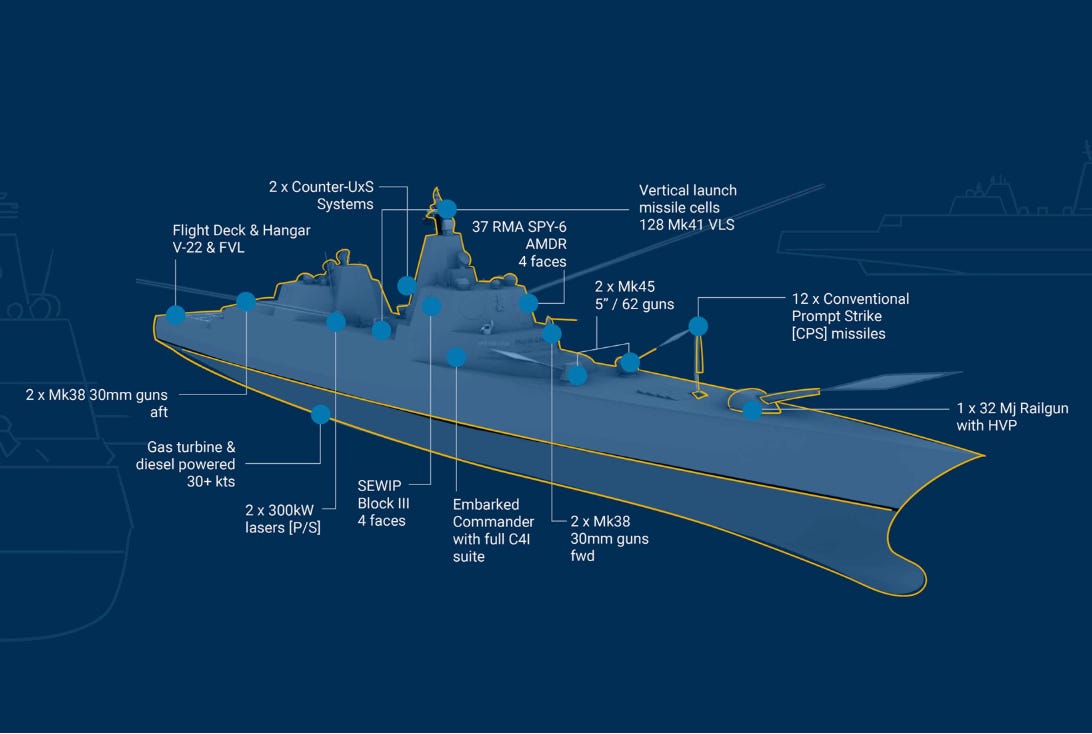
One of the least helpful aspects of the modern-day battleship debate is the fact it has been so highly politicized.
Whenever an announcement of a milestone comes up, the first thing that has to be done in the search for useful information is to filter out the rabid partisans on the left and right who will support or oppose anything strictly through a partisan lens. Both sides have two subspecies: mindless partisans to just call names and flick spittle about, and the professional partisans who will make an argument based on fact or well-founded opinion…filtered, but useful in the broader discussion.
One of the more valuable reference documents on most issues involving warship development continues to be the Congressional Budget Office (CBO). Yes, yes, I know the critiques, but their record is better than most. No need to plow into that again, I will just reference you to the interview we did on the Midrats Podcast with Eric Labs back in February of this year.
Well, if you’re looking for a good reference document on the state of play of BBGN-1, this is your week. Yesterday, the CBO put out their report, The Navy’s New Battleship Program: Costs and Implications for the Shipbuilding Industrial Base.
What is good about it from my point of view at least, is it gives you a set of about as objective facts as you can find inside a commute of DC. As such, it gives you the opportunity to discuss choices. There are a lot of choices and decisions to be made about fleet design, some of them involving BBGN-1 that we’ve made here which you can find at the first hyperlink at the top of this post.
Before we get to some pull quotes, I want to lead with a point I originally put at the end of this post. To a fault, I look for patterns, habits, recurring issues. If significant changes are not put into a system with regards to people, policy, or procedures, then the odds are that past patterns, habits, and recurring issues will reappear.
As you would expect from CBO, you have a numbers based argument, a foundation that has enabled the disastrous Cult of Efficiency and Transformationalists to create a disgraceful breaking yard of failed and cancelled programs. LCS, DDG-1000, CG(X), FFG-62. Poor program management and weak-hand leadership destroyed the utility of three of them, lack of vision, control, and salesmanship killed the 4th before a design was ever even finalized.
The result was billions of dollars spent for limited to no combat utility, generations of advanced designs never making it to the fleet, and an industrial base flat-footed in the face of the greatest challenge to our nation on the high seas in four decades.
Speaking of billions…
The total cost of the Navy’s new nuclear-powered battleship program would be about $275 billion (in 2026 dollars) over the 2027–2056 period. The first ship would cost about $23 billion. For the 15 ships that would be purchased through 2056, the cost would average slightly more than $18 billion per ship.
How does that compare to the other large nuclear powered warship?
The only Navy ships whose costs are comparable to CBO’s estimate for the BBGN are the Ford class nuclear-powered aircraft carriers. The Navy currently has 11 Nimitz class aircraft carriers and 1 Ford class aircraft carrier, with 3 more under construction. CBO estimates that future Ford class ships under the Navy’s 2027 shipbuilding plan would cost about $22 billion each. Aircraft carriers do not carry missiles, unlike surface combatants and most submarines, but they have an air wing composed of several dozen aircraft that can fly hundreds of sorties over days or weeks to launch bombs and missiles.
An aircraft carrier is not really a warship without its carrier airwing. Baking the cost of the aircraft should be done, otherwise it is like estimating the cost of a surface ship without factoring in the cost of VLS cells and gun mounts.
Let’s be conservative and state that a low-end carrier airwing has: a mix of 44 F/A-18E/F and F-35C, 5 EA-18G, 4 E-2D, and eight MH-60S with the MH-60R distributed amongst the small boys and of course, the supporting COD Ospreys who are usually ashore. If you just count the carrier based aircraft, that gives you:
44 Super Hornets at $67.5 million each = $2.97 billion
5 Growlers at $68 million each = $340 million
4 Hawkeyes at $80 million each = $320 million
8 Seahawks at $30 million each = $240 million
That exceptionally low-balled figure for the capital costs of an airwing adds up to $3.87 billion per carrier additional cost to deploy, for a follow-on FORD Class unit cost of $25.87 billion compared to the follow-on BBGN ships estimated $18 billion.
Last October before the announcement of BBGN-1, I made a few guesses that actually didn’t turn out too off the mark. One of them was a planning proposal benchmark that we should expect a BBGN-1 to cost about 2/3 the cost of a Ford CVN.
$25.87 x .6667 = $17.24 billion.
My estimate for the cost back last October—done with a gun to my head, was not that bad. As such, no one is allowed to blanch at the cost of BBGN.
See the good stuff you get for free by reading CDR Salamander every day? If that doesn’t encourage you to become a paid subscriber, I don’t know what will.
NB: I am not going to use the cost of the initial ship, there are all sorts of issues involved with that cost for every class that skews discussion. It is the follow-on ship cost that matters.
One more comment on that last pull quote, specifically nuclear power. Our carriers are nuclear powered and can, ahem, go much faster then any of their escorts…and keep at it for a very long time. However, because they don’t have a single escort that can keep up with them in contested seas, they cannot take full advantage of their speed. Instead, they must slow to the best speed their conventionally powered escorts can sustain…and at those speeds those escorts will consume exorbitant amounts of fuel, further tethering the strike group to their few and fragile oilers.
After announcing the program, the Navy indicated that it would award sole-source contracts to Leidos Gibbs & Cox for assistance with surface ship design engineering and to Bath Iron Works and Ingalls Shipbuilding for assistance with designing the ship. Bath and Ingalls currently build many of the Navy’s surface combatants and amphibious warfare ships. In its budget submission to Congress, the Navy estimated that the first ship of the class, known as the lead ship, would cost $15.1 billion (in 2026 dollars) and that the average cost of the second and third ships would be $10.2 billion. Those estimates were for a conventionally powered ship—that is, one without nuclear propulsion.
…
By comparison, CBO estimates that for a conventionally powered battleship with a full-load displacement of 35,000 tons, the lead ship would cost $21.3 billion, and the 14 follow-on ships would average $15.9 billion each, for a total of $243 billion. The total cost of $275 billion estimated for the 15 nuclear-powered ships would be about 13 percent greater.
Switching to nuclear power would reduce the battleship’s operating costs over time by eliminating the need to purchase fuel. CBO does not have enough information to estimate those potential savings, which would depend on the final design of the ship and the specifications of the conventional propulsion plant it otherwise would have used.
Nuclear power is worth it…and as we discussed earlier…is a long-standing requirement.
We’ve gotten this far without reminding everyone of the scale of BBGN-1, so let’s reestablish that baseline understanding.
The battleship would have a full-load displacement of 35,000 tons or more, a length of 840 to 880 feet, and a sustained speed in excess of 30 knots.3 The Navy revealed those specifications before deciding to use nuclear propulsion on the ship, a change that would significantly increase the cost of the ship and affect its design.
If built to those specifications, the ship would be the largest surface combatant in the world and larger than any surface combatant built for the Navy since World War II.4 It would be more than three and a half times the size of the Navy’s Arleigh Burke class guided missile destroyer and more than twice the size of the Zumwalt class guided missile destroyer
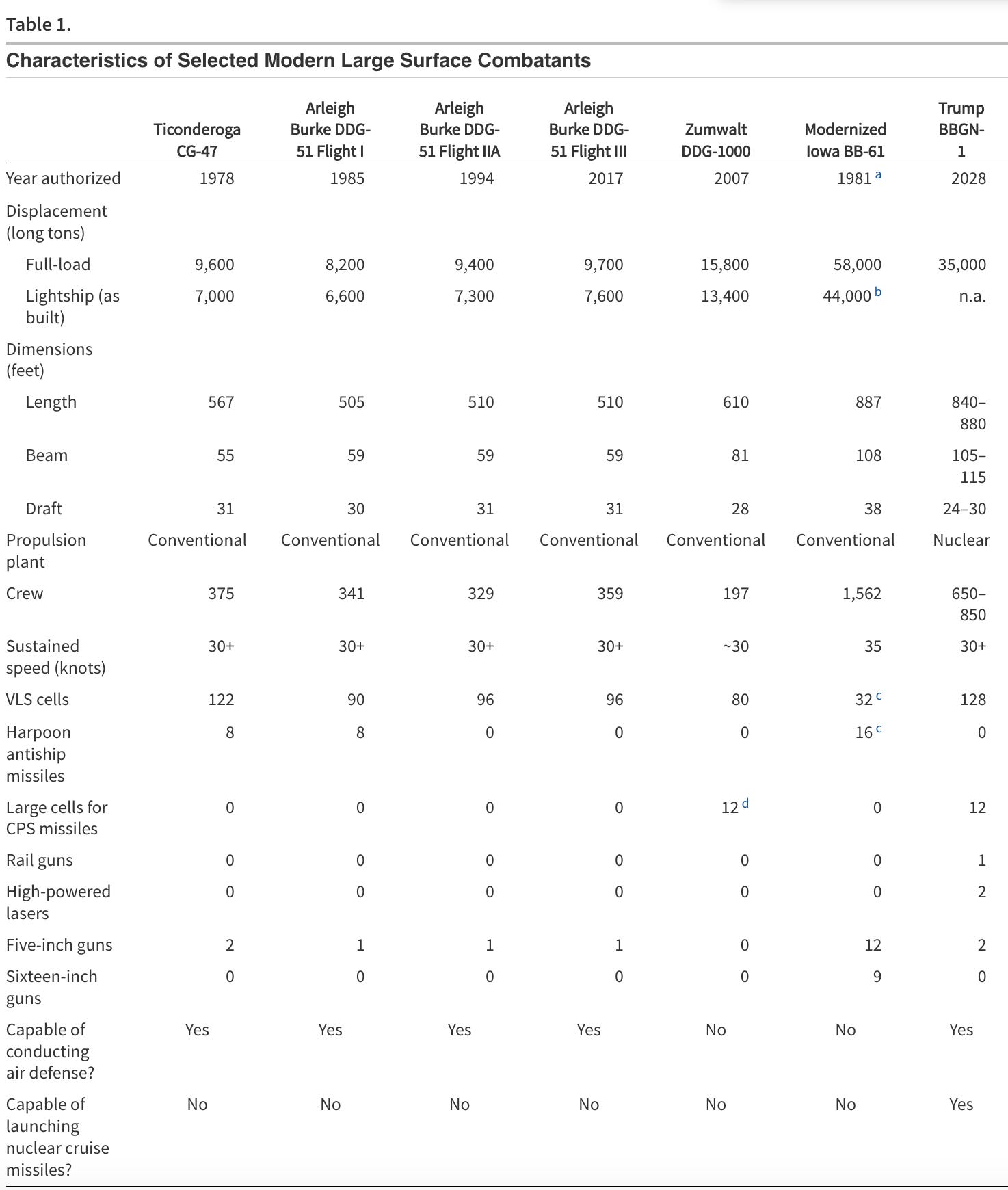
A few notes on the above.
128 VLS cells is what we had with the TICO CGs. There is expanded news here that I will cover with the sidebar at the end of this post…but stick with me here and don’t get distracted. We’ll get there in a bit.
I remain unhappy with just 12 Conventional Prompt Strike missiles, but compromises must be made.
That damn SLCM-N is still there. It is a bad idea, distraction, and unappreciated cost inflator. Again, just say “no” to the nuclear autists.
One of the more important details of this discussion is hidden in page 5, and I want to make sure no one misses it:
…the final assembly of the ship would be performed by Newport News Shipbuilding. That shipyard is the only new-construction shipyard already certified for work on nuclear-powered surface ships. The battleship’s final assembly would take place at Dock 12, which is currently used to build aircraft carriers.10 Newport News Shipbuilding is behind schedule on constructing three aircraft carriers, as well as many submarines. Adding the final assembly of a nuclear-powered battleship to the shipyard’s workload could lengthen the delays for those programs, in addition to delaying the construction of the battleship itself.
Dock 12 is the Achilles' Heel of American sea power. This simple fact is unappreciated and it should give you nightmares. It is our version of the dry docks at St. Nazaire, and we should hope that no one has a Cambletown ready to head up the James River.
This next paragraph is very hard to argue with, and can be disheartening:
Given the history of the DDG(X) and the ongoing delays in producing ships, a clean-sheet design of a much larger ship is unlikely to be ready in time for production to begin in 2028. A ship as large as the BBGN would require significantly more work to design and more detailed digital models than the DDG(X) would have needed. To address concerns about the relatively short timeline for developing the BBGN’s design, the Navy plans to incorporate “modern digital engineering, advanced production practices, and [artificial intelligence]-enabled design tools to reduce cost and schedule risk from the outset.”17 But the Navy’s inability to complete designs for simpler ships, such as the FFG-62 Constellation class guided missile frigate, in a timely way suggests that the service will face challenges with the BBGN.
The reality is, if we stick with the same people, processes, and procedures that we have so far this century, we will have this problem. Please tell me that there are plans to bring in the good folks from Palantir with ShipOS, and we’re not going to plow away with our legacy “system” that has failed us over and over.
The Navy’s DDG-1000 destroyer … experienced substantial cost growth because of other factors, including construction that started early in the design phase and reliance on a number of technologies that were still being developed. If the Navy and shipbuilders incorporated producibility features into the BBGN’s design and avoided the challenges that affected the DDG-1000, the BBGN’s cost by weight could be lower than CBO estimates.
“If” is carrying a lot here, and I hope it does…but we could help ourselves if we don’t make the mistake of the Transformationalists earlier this century.
…if the Navy moves too quickly to start building, it runs the risk of cost growth from concurrency—that is, from starting construction before the ship’s design is complete. A substantial overlap between design and construction has caused construction problems and cost growth in other Navy and Coast Guard shipbuilding programs, including the littoral combat ship and the Constellation class frigate.
…and yes, I acknowledge that the Constellation class frigate (PBUH) was not part of the Age of Transformationalism™, but it used the same people, processes, and procedures of them…with the expected results.
There’s your CDR Salamander CBO Report Quicklook. There’s a lot more info there. You really should give it a read.
Sidebar:
Did you catch note 5?
Lockheed Martin has developed a new method for building the Mark 41 system that could increase the number of missiles in a set physical space on a ship by 25 percent. Thus, a missile field on a DDG-51 class destroyer that contains 64 missile cells today could in the future be replaced with a system that contains 80 missile cells. If that method was used on the battleship, the 128 planned missile cells could potentially become 160 cells or, in the absence of CPS missiles, as many as 200 VLS cells.
I got the brief on this earlier this year. I believe I have mentioned this before, but were I Emperor the one thing I would require is that every Arleigh Burke DDG that is going into the yard for an extended maintenance period should have this upgrade. Every Arleigh Burke presently under construction should as well.
We have a problem—too few ships with too few VLS cells. There is a way to accelerate correction of the latter as we work on the former.
I am simply gobsmacked as to why this isn’t happening.

1. As with CVNs, any cost comparison between nuclear and conventional propulsion needs to include the added oilers…and their escorts.
2. Strategic mobility is undervalued by Goldwater-Nichols. A CVN with a BBGN escort can move 700+ nm/day. A CVN tied to conventional escorts is good for ~500nm/day.
3. We need a second yard building nuclear combatants. The Nimitz-class CVNs are facing a serious block obsolescence issue. Not to mention having a 10-carrier Navy against 15-18 carriers of need. And HII needs the competition.
4. NAVSEA needs a brain transplant. NAVAIR has its problems, but the ship community seems clueless when it comes to systems engineering.
5. Acccording to AvWeek, the Navy is requesting bids for a next-generation SAM family that can be multi-packed in Mk 41 VLS cells.
"...See the good stuff you get for free by reading CDR Salamander every day? "
well duh! yeah!