
The Dragon's Sad Tale
decline by design

You have to be careful about assumptions, especially those you grew up with that are comforting, convenient, and once seemed so real, so solid, that they just were part of the landscape. They just, were.
For over a century, there was one jewel in the special relationship between the United States of America and her mother country, Great Britain. That jewel was the Royal Navy.
From the convoys and battleship divisions of the Great War, to Five Inch Friday off the Al Faw almost 90 years later, we always knew that there was another highly capable navy out there we could rely on—the Royal Navy and her Commonwealth.
During the interbellum, when the U.S. Navy was on par with the Royal Navy, we knew our friend was strong. Even when we passed her strength as WWII bled her white, we still knew the power she brought to sea.
She knew her existence was only secured by a strong navy. She’d never abandon that, would she?
During the Cold War, she fought with us sometimes and demurred at others—but regardless, we knew that the closer you came to the North Atlantic, you were in her waters.
Regardless of what happened, from the GIUK Gap, north—she would have it covered with our allies, or would be right next to us.
From Gibraltar in the west to Cyprus in the east, for centuries no movement was seen or could pass without wondering where the Royal Navy was.
Well within living memory, she could sortie a fleet all on her own and retake her territory from a hostile power.
That was then. This is now.
Let’s put their domestic political issues of today to the side for a moment, and just look at where they are—and where they will be for quite a while.
U.S. reality of securing the open seas are a long way from the vanity of denial and delusion such as Mike Mullen’s 1,000 Ship Navy. Even if we have reliable partners, nations have agency. Even if our closest ally of the last century does have the desire to come to our aid at sea—what can she bring?
We need to stop pretending we have a Royal Navy we knew in our youth or even that of two decades ago. No, we have something altogether different. Something shrunken. Something weaker. Something that is, in the end, really sad. A symptom of a nation who has lost an enthusiasm for herself or even an understanding of her national interest and led by a ruling class that seems uninterested in stewardship.
The state of the Royal Navy—a condition that took decades of neglect to manifest into its form today and will take decades to repair if there is ever the will to do so—has become, as navies can often do, a symbol of the state of the nation it serves.
There is a lesson here, not just for the United States, but all nations who consider themselves a naval power.
If you fail over and over to properly fund, develop, train, and support your navy, you can coast for quite awhile on the inertia of the hard work and investment of prior generations, but eventually that exhausts itself, and you are left with the husk of your own creation.
Yes, I’m looking at you, DC.
A token of this problem has revealed itself in all its saddest manifestation.
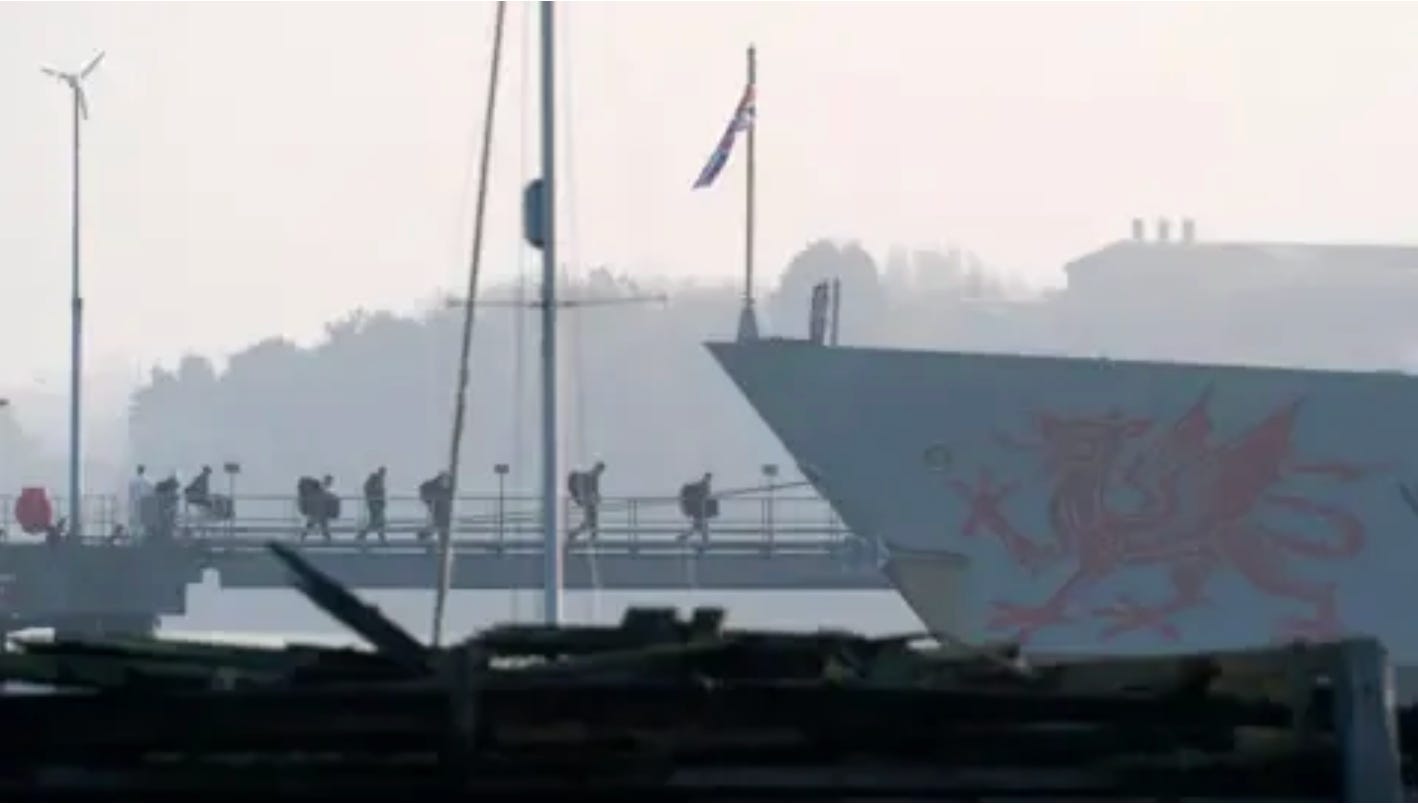
Preparations are continuing to get HMS Dragon ready to sail to help protect British troops in Cyprus with confirmation that the earliest she will leave Portsmouth is Wednesday (March 11).
The Type 45 destroyer is this afternoon (March 9) at the Portsmouth Upper Harbour Ammunition Facility, and according to tomorrow’s shipping movements she is due to be moved to BOWS S berth in the afternoon. The Royal Navy has said that she will depart some time this week.
As previously reported by The News, the government confirmed on March 3 that the UK would be sending the Portsmouth-based warship, one of the Royal Navy’s six Type 45 air defence destroyers, after RAF Akrotiri on Cyprus was hit by a drone.
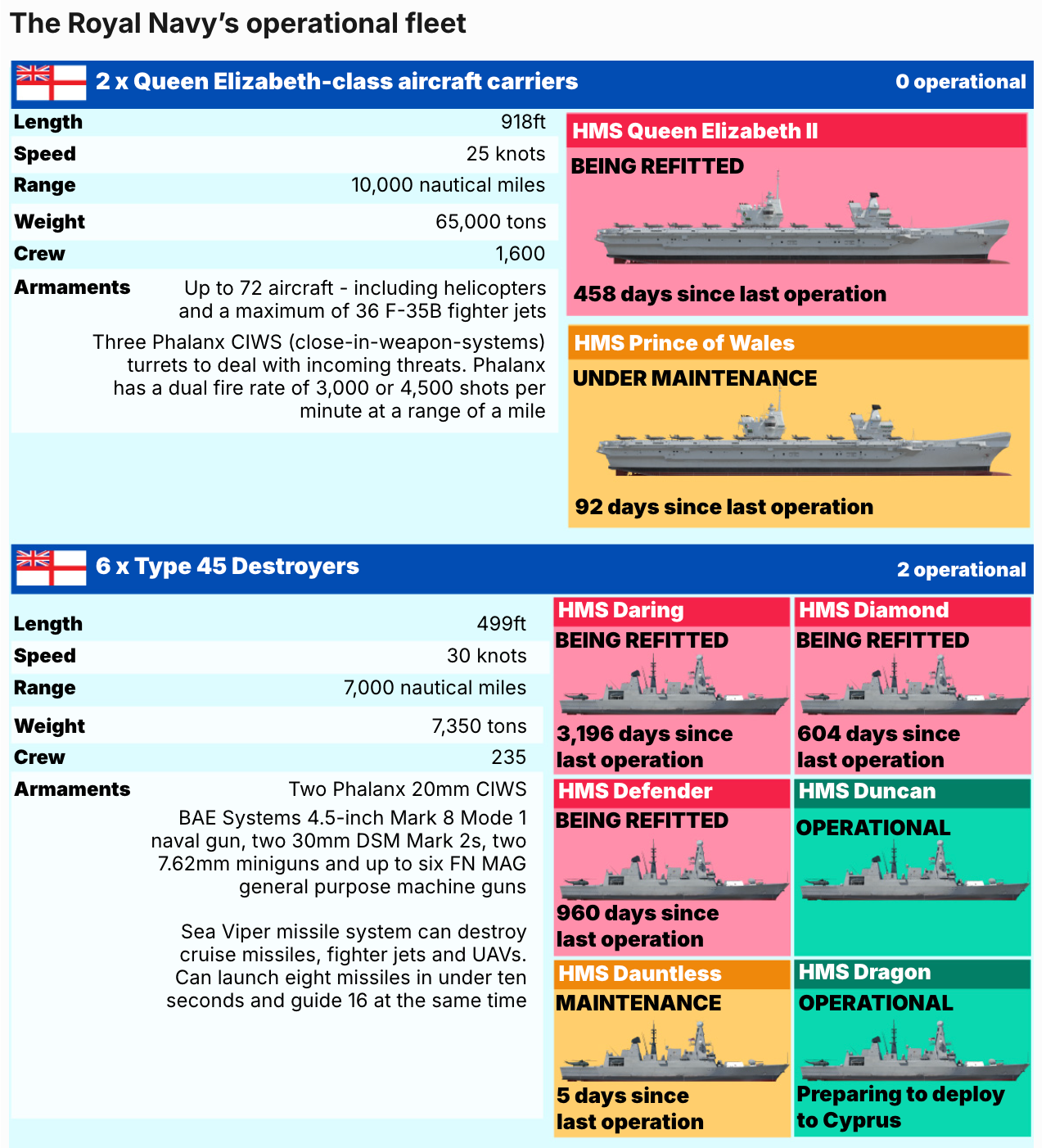
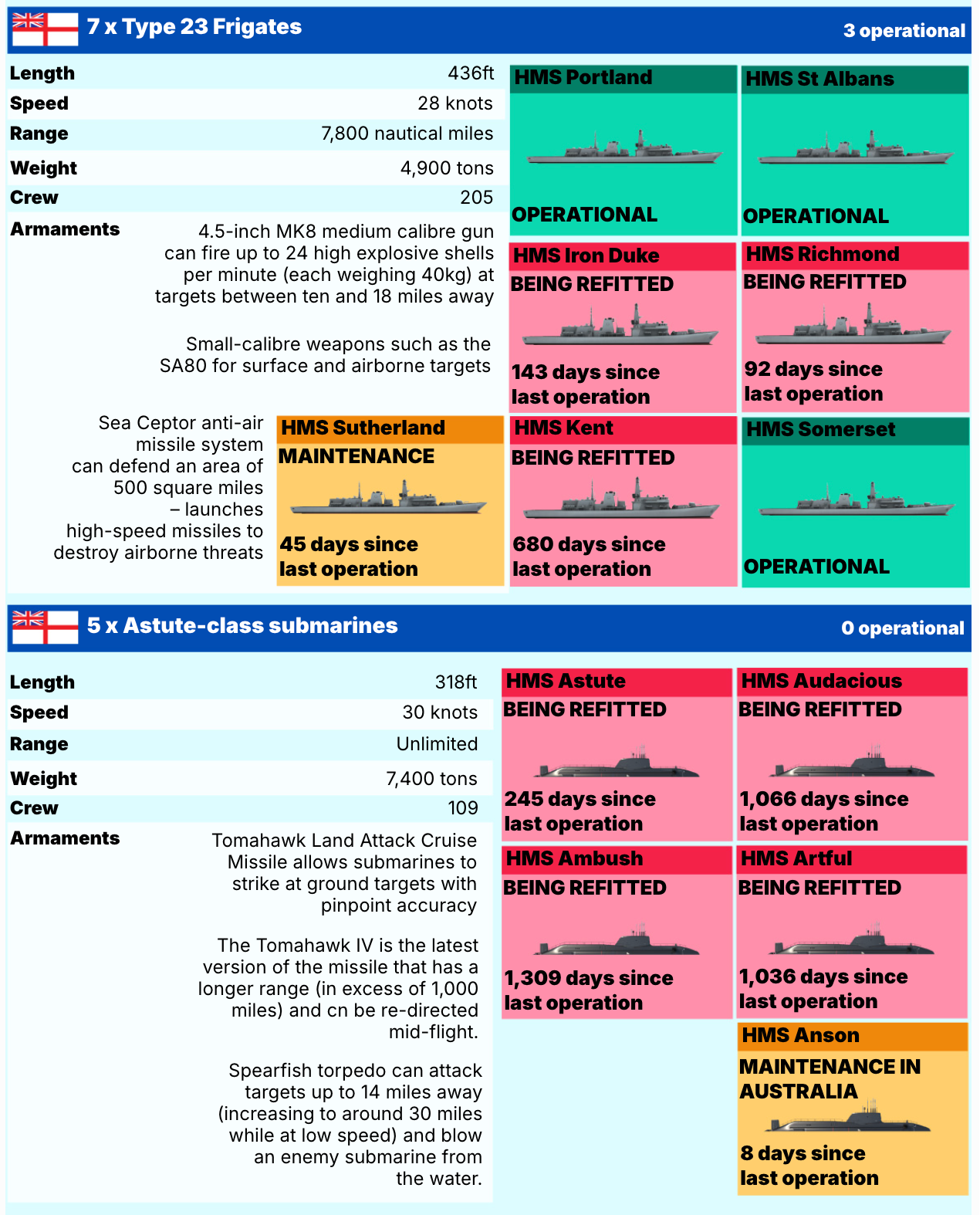
This graphic from The Daily Mail is helpful in understanding not just how small the Royal Navy has become, but how few of its warships are even ready to go to war.
If you’re looking for a further fleshing out of the issue, Thomas C. Theiner has a sad tale of woe.
Two destroyers and three frigates. HMS Duncan just came back from exercises and for reasons unknown is a worse option than waiting for HMS Dragon to finish fitting out.
This is simply one thing: humiliation. The sovereign British bases on Cyprus were attacked by Iran…and the response…well…sigh. Richard the Lionhearted conquered the island first in 1191 just so he could get a break from seasickness on the way to the Crusades (one of my favorite historical maybes), and the British negotiated oversight from the Ottomans in 1878 only to annex it outright in 1914…and yet…well…sigh…the French will have to do it with an assist of the Spanish (!), Italians, and Dutch.
One would be hard pressed to find a nation’s ruling elite in the modern era who has so completely failed in the stewardship of their nation’s security.
There are rumors that HMS Prince of Wales may be ready for a deployment soon, but there are not enough ships to properly escort her. The Royal Navy will have to go begging to allies.
We covered the French deployment yesterday. Yes, as we discussed, it is not sustainable and I’d be curious about their individual unit readiness, but it is a signifiant fleet going to sea.
This is not unknown in the United Kingdom. I think, more than most, Jacob Rees-Mogg, outlines the issues well from inside their lifelines.
This is a deep-rooted failure of the state to recognize what its duty is.
A final postscript to this point, and it isn’t a happy one. It is a very American one.
I have great affection for our European allies. I served with them for years. I raised my children in their nations during their most formative years. I will always rise to ask my nation to help them in their times of trouble—but I also have to be realistic towards my own nation’s security requirements.
In the next few years, we may very well see this century’s high water mark for European military capabilities, especially at sea. For some, that high water mark is already behind us.
Most of our traditional European allies have exhausted their desire to be involved in other people’s conflicts—even when on their doorstep. They no longer concern themselves with larger issues, their ruling elite only concerned with petty social signaling or, increasingly, bending national efforts toward their own personal wealth building.
Their deathbed demographics combined with suicidal migration policies have condemned them to a mid-century (which starts in four years for those keeping track) that will be marked by growing sectarian strife, fraying social cohesion, cultural disintegration, and political upheaval.
They will be focused on internal challenges with collapsing welfare states, and the resulting movements toward renationalization and subsequent sovereignty conflicts—hot and cold.
Whatever the future holds for the U.S. and her friends in the Middle East, the Indo-Pacific, or the Western Hemisphere—we should not expect much of any help from Europe of any significance.
In many cases it may not be that they don’t want to, it will simply be that they can’t.
Royal navy is like a old patient in hospital . All his treatment goes towards trading symptoms and now he is thinking of the good old days
> Most of our traditional European allies have exhausted their desire to be involved in other people’s conflicts—even when on their doorstep.
Sir, let's face it. Most of them don't even care enough to be prepared for their *own* conflicts, as the parlous state of the Royal Navy shows.